By clicking “Accept”, you agree to the storing of cookies on your device to enhance site navigation, analyze site usage, and assist in our marketing efforts. View our Privacy Policy for more information.
Supply Chain Risk Intelligence: How Security Teams Identify Exposure and Act Faster
The supply chain risk intelligence you need to alert you to emerging threats, rapidly understand your exposure and prioritise action.
Risk Ledger
|
Company
November 20, 2026
|
15
mins read
Share
Quick answer
Supply chain risk intelligence is the practice of connecting supplier evidence, dependency data, threat signals and business context so security teams can tell whether an alert affects them and what to do first.
It works alongside TPRM and threat intelligence rather than replacing them, turning their outputs into exposure and response decisions.
A CVSS score of 9.8 tells you how serious a vulnerability is in general, not how exposed your organisation is to it.
Dependencies set the priority, so a fourth party behind five critical suppliers can matter more than a direct supplier running expense management.
Each alert should answer five questions: what changed, who might be affected, how confident you are, what the business impact could be and what should happen next.
No single data source is enough, because questionnaires, external monitoring, dependency maps and supplier communications each establish something the others cannot.
When a new risk signal comes in, supply chain risk intelligence translates your raw supplier and threat data into meaningful response decisions.
Supply chain risk intelligence makes the outputs from your third-party risk management (TPRM) tools and threat detection software operationally useful by connecting contextual supplier, supply chain dependency, emerging threat and business data, so you can rapidly understand your exposure and prioritise action.
From hidden concentration points to fourth-party vulnerabilities, modern supply chain risks can have a hugely disruptive impact on your systems or services without directly penetrating your perimeter. Security teams know this, but they face an uphill battle with inadequate and disjointed supply chain defences. Our 2026 State of Supply Chain Security survey found that:
Less than one in three organisations (30%) have full visibility into the entire chain of subcontractors.
A mere 6% can accurately map their exposure across their supplier ecosystem following a major supply chain cyber incident in under four hours.
55.4% of TPRM functions provide limited or no direct access to security teams at their direct suppliers - let alone at fourth-party dependencies.
This guide will show you how supply chain risk intelligence fills these gaps. In particular, you will learn:
The difference between supply chain risk intelligence, TPRM and threat intelligence
How supply chain risk intelligence works: from signal to action
Which data sources create a reliable supplier risk picture
How supplier dependencies change the priority
What to look for in a supply chain risk intelligence platform
What is supply chain risk intelligence?
65% of large organisations now cite supply chain risks as their primary cyber resilience challenge (up from 54% in 2025), but their ability to combat these risks is hampered by a disjointed approach - from third-party supplier assessments and fourth-party dependency mapping to external vulnerability scanning tools and dark web monitoring.
Supply chain risk intelligence brings all of this raw data under one umbrella with contextual, collaborative and actionable insights, pulled from both external and internal sources, that helps you gauge the potential impact of a risk to your organisation and respond accordingly.
Supply chain risk intelligence is contextual. Supplier data, vulnerability signals and breach alerts all provide intelligence, but tell you little without context. For instance, a direct supplier changing its payments processor might seem innocuous until you see there’s now a concentration risk or a software vulnerability might seem irrelevant until you find out the software is used by 10 of your critical suppliers. Supply chain risk intelligence provides that context by enabling your data tools to work in harmony.
Supply chain risk intelligence is collaborative. No organisation is an island in the era of interconnected supply chains, so trying to identify, assess and mitigate supply chain risks by yourself is wasted effort. Supply chain risk intelligence brings in network-level insights that makes your intelligence stronger and enables you to act faster, such as the ability to directly contact other InfoSec teams during a live breach or indirectly share supplier assessment data (i.e. seeing another similar organisation's review of a shared supplier’s security).
Supply chain risk intelligence is actionable. Security teams gather copious amounts of security data, which do not help you prioritise remediation. For example, you might receive a security report or CVE alert, but without overlaying this external threat information over your network map, you cannot see the impact to you or know where action is needed most. That’s what supply chain risk intelligence does.
Supply chain risk intelligence vs TPRM, SCRM and threat intelligence
Supply chain risk intelligence is not a replacement for your TPRM programme or threat-intelligence tooling. It complements your existing TPRM, threat intelligence and supply chain risk management (SCRM) approach by making their outputs operationally useful together. Here are the key differences.
Third-Party Risk Management (TPRM)
TPRM focuses on assessing and governing third-party suppliers. As you’re entering a direct contractual relationship, you can demand third-party suppliers take security assessments as part of the onboarding process and periodically after that (usually annually) to ensure they still comply with your pre-set policies and controls (and relevant regulations).
Armed with data from these assessments, you can ‘score’ individual suppliers and mandate actions to improve their security posture, but you have limited visibility beyond third parties and cannot easily assess how supply chain risks and live threats could affect your third parties (and therefore impact you).
Supply Chain Risk Management (SCRM)
SCRM focuses on how you manage risk across the supply chain lifecycle. From establishing supplier policies and choosing controls to setting up teams and creating disaster recovery plans, SCRM is the architecture that houses your resilience to supply chain risk. It’s how you differentiate risks, gather quality data, decide on your risk appetite and deploy your resources.
Your SCRM set-up helps you measure, respond to, and recover from supply chain risks, but lacks the actual risk detection alerts and ecosystem-wide data that makes you aware of emerging risks and their potential blast radius.
Cyber threat intelligence
Cyber threat intelligence focuses on emerging threats, threat actor activities, new vulnerabilities and targeted attacks. It tells you when breaches, outages and attacks are happening and where - be it malware embedded in a software update, a data breach at a SaaS supplier or a ransomware attack on an enterprise organisation.
Like seeing a beacon on the horizon, cyber threat intelligence lets you know action is needed, but not what action to take. It does not provide the wider context that helps you understand your exposure and make the appropriate incident response.
Supply chain risk intelligence is the glue that binds all three of these together. By combining elements of all three approaches, as well as continuous supplier monitoring, supply chain risk intelligence helps you understand how your business could be impacted by a risk, so you can act faster.
How supply chain risk intelligence compares with TPRM, supply chain risk management and cyber threat intelligence
Discipline
Main role
Typical outputs
TPRM
Main roleAssess and govern third-party relationships
Typical outputsAssessments, findings, approvals, exceptions and remediation
Supply chain risk management
Main roleManage risk across the supply chain lifecycle
Typical outputsPolicies, risk treatment, controls and resilience plans
Cyber threat intelligence
Main roleUnderstand threats, actors, vulnerabilities and campaigns
Typical outputsAdvisories, indicators and threat assessments
Supply chain risk intelligence
Main roleConnect supplier, threat, dependency and business context
Typical outputsPrioritised exposure and response decisions
Why supplier alerts still leave security teams unable to answer: “Are we exposed?”
You receive an alert to an emerging threat with a CVE score of 9.8, indicating its potential severity. But, on its own, this score tells you nothing about how exposed you are or how it could potentially impact your organisation. As the security analyst or even the CISO, you don't want to start spinning up an incident response plan for something that's minor, but you also don’t want to ignore something that could disrupt your critical services. So what do you do?
This is the problem facing security teams that exclusively rely on TPRM and threat detection software. While these help you assess third-party supplier risk and know when threats emerge, structural issues prevent this intelligence from being truly actionable. That’s because, with third-party risk management and threat detection software:
Supplier data is stored across disconnected systems. From procurement and cybersecurity to risk management and operational resilience teams, supplier data is often stored in different places by different departments using different terminology (i.e. suppliers fill in assessments in hundreds of different ways). This makes it hard to compare and act on.
Assessments are collected at different points in time. TPRM assessments are, by their nature, snapshots of a supplier’s security posture and digital connections at a single point in time. But these do not sit still. It won’t be the same in three months, let alone a year later. Without a reliable, up-to-date view of which suppliers use which technologies, you can’t accurately assess supplier criticality or know who to prioritise to mitigate risk.
You get alerts without product, service or relationship context. Your suppliers are not equal - some are more critical than others, depending on the business services they support, the data they hold or the level of access they have to your systems. But security alerts and traditional TPRM don’t differentiate by suppliers' criticality, so you don’t know where to focus.
There is unclear supplier ownership and outdated contacts. To mitigate supplier risks or take action on a new alert, you need direct engagement with your suppliers’ security teams to clarify controls and discuss remediation. But TPRM contact lists rely on manual verification and updates (i.e. you need to check when the contact at your hundreds of suppliers changes) and does not provide a dedicated channel of communication (instead relying on email or phone).
Inability to distinguish possible from confirmed exposure. Step one after receiving a risk alert is confirmation. You need to double check the vulnerability by looking at trustworthy sources, such as the NCSC, NSA or CISA, see how many of your suppliers are affected, and then confirm that exposure with them rapidly. With traditional TPRM, this is a time-consuming exercise.
Limited visibility beyond direct suppliers. TPRM enables you to list your direct suppliers, but you struggle to see who those suppliers depend on. Only 30% of organisations have full visibility beyond direct suppliers, but the invisible web of 4th, 5th, and nth party connections is where some of the highest-priority vulnerabilities and concentration risks lie.
The five questions supply chain risk intelligence must answer
In order to make sense of the outputs from TPRM and threat intelligence, many security teams try to make them quantifiable by assigning a risk score. While a score might make prioritisation easier, an arbitrary number fails to answer the five key questions that actually determine if a risk should be a priority. These five questions are what supply chain risk intelligence answers.
What’s changed?
Whenever there’s a new vulnerability, dependency change, breach or threat alert, your supply chain risk intelligence should provide context on the change that’s happened, such as:
Changes to supplier controls, policies, certifications and product-level information.
Expired documents, overdue reassessments, unresolved exemptions and old contacts.
Exposed services, asset changes, leaked credentials, certificate issues and known vulnerabilities.
Acquisitions, agreements with new subcontractors, service redesign and new shared providers.
Who might be affected?
With supply chain risk intelligence, you should be able to quickly identify which of your direct suppliers, products, services, fourth parties and shared providers are potentially affected by this change. While you can verify direct exposure using internal information, network-wide mapping is essential for seeing which deeper tier connections are potentially impacted and how this could affect you.
How confident are we?
No CISO wants to escalate or ignore a threat based on hearsay, so your supply chain risk intelligence should be able to check whether the exposure is suspected, inferred, supplier-confirmed or independently-verified. That means checking trustworthy sources (i.e. NCSC etc) and confirming with affected suppliers.
What could the business impact be?
In a crisis, speed matters. Your supply chain risk intelligence should be able to assess the critical services, data, systems, customers and regulatory obligations affected, so you can prioritise the risk based on its potential impact to your business.
What should happen next?
Every risk needs a response - ranging from learning to immediate action. Your supply chain risk intelligence should inform you whether you need an investigation, supplier outreach, escalation, remediation, acceptance or continued monitoring.
Quick check
Five questions to test how exposed your supply chain is
Use these to find where your visibility, prioritisation or response would slow you down in an incident.
1
Can you see beyond your direct suppliers?
Subcontractors and shared providers carry much of your real exposure, and direct supplier records won't show them.
2
Do you know where your concentration risks are?
When several suppliers rely on the same provider, one incident there can hit all of them at once.
3
Could you map exposure in under 24 hours?
Working out which suppliers are affected through email and spreadsheets can take days during a live incident.
4
Are your suppliers held to consistent security standards?
Answers collected in one standard format can be compared across suppliers and checked against your own requirements.
5
Do you act on emerging risks before they become incidents?
Continuous monitoring and a direct line to supplier security teams let you act on a signal while it is still a signal.
How supply chain risk intelligence works: from signal to action
When a risk emerges, the quicker you understand your exposure, the better you manage the situation. That's what supply chain risk intelligence does: it helps you quickly turn an alert signal into a meaningful response decision.
Take the following scenario, for example. An alert comes in that a software package used by a SaaS supplier has been injected with malware. This is what you should do.
Collect relevant evidence. From supplier-provided assessment evidence and internal procurement records to external monitoring and threat intelligence, gather all the information at your disposal that relates to this specific threat and supplier.
Match the signal to the right supplier, product or service. Given companies have different arms, names and departments, ensure you know the exact domain, legal entity and technology affected.
Add dependency and business context. Identify direct relationships to the supplier, as well as important shared providers and supported services. For instance, look at your supplier map to pinpoint which of your critical third-party suppliers use the affected suppliers’ services and what services those third-party suppliers perform for you.
Assess relevance, confidence and potential business impact. General technical severity is not equal to the severity for your organisation, so analyse the exposure based on the number and criticality of suppliers potentially impacted, and what those suppliers going offline would mean to your business operations.
Prioritise and route action. Assign owners, contact suppliers, request evidence and escalate according to criticality. For example, contact the most critical suppliers with targeted questions that determine their use of the affected supplier, what customer data, systems or services could be affected, what containment and remediation actions have been completed and when the next update will be provided.
Which data sources create a reliable supplier risk picture?
Organisations use a wide variety of supplier risk data sources. On their own, they can provide useful snapshots, but each one has its own limitations. For example:
Vendor questionnaires. These can help you ensure your direct contractors have certain security controls in place and meet compliance regulations. However, assessments are usually non-standardised, making it hard to compare data, and are also taken periodically, so the information is not always in date.
Dependency data. Data on third, fourth and nth-party dependencies is essential in an age when supply chain attacks do not respect contractual boundaries, enabling you to see the deeper tier suppliers you indirectly depend on to carry out your services. However, without this information overlaid on a supplier map, it’s hard to see how these dependencies are affected when a threat emerges.
External security monitoring. External security monitoring highlights exposed ports and expired certificates, revealing which of your suppliers are likely to fall foul of regulations. But this monitoring reveals nothing about your supplier's internal access controls or incident response capability.
Ultimately, no standalone data source is enough on its own. Some are more trustworthy than others and some need more context to be useful. But supply chain risk intelligence combines the following data sources together to provide a clear and actionable picture of your changing supply chain risk.
What each supplier risk data source contributes and what it cannot establish alone
Data source
What it contributes
What it cannot establish alone
Supplier questionnaires and evidence
What it contributesInternal controls, policies, processes and certifications
What it cannot establish aloneWhether every answer remains current
Internal supplier records
What it contributesOwnership, criticality, services, access and data use
What it cannot establish aloneCurrent external exposure
External security monitoring
What it contributesInternet-facing weaknesses and posture changes
What it cannot establish aloneInternal controls or compensating measures
Vulnerability intelligence
What it contributesSeverity, exploitation and affected technologies
What it cannot establish aloneWhether a supplier uses the affected product
Threat intelligence
What it contributesCampaigns, actors, techniques and emerging activity
What it cannot establish aloneMaterial impact on a specific supplier relationship
Dependency data
What it contributesFourth parties, shared services and concentration points
What it cannot establish aloneWhether the dependency is currently affected by a threat
Supplier communications
What it contributesConfirmed impact, remediation and timelines
What it cannot establish aloneWider impact beyond the responding supplier
Incident and remediation records
What it contributesHistorical decisions and unresolved findings
What it cannot establish aloneNew exposure that has not yet been detected
What does continuous supplier monitoring mean in practice?
Over the last few years, it’s been great to see organisations move away from annual spreadsheet-based assessments (only 3.8% still do). But 53.6% still rely on quarterly or event-triggered updates and just 40.6% of organisations have fully automated, real-time monitoring of their critical suppliers' internal security controls.
Continuous supplier monitoring matters. You cannot proactively mitigate supply chain risks without maintaining awareness of relevant risk changes and ensuring those risk signals lead to a clear investigation, decision or action. Here’s the key things to monitor for.
What to monitor continuously across your suppliers and the key focus for each
Monitor for
Key focus
Updated supplier controls
Key focusChanges to controls, policies, certifications and product-level information
Expired certifications and overdue evidence
Key focusExpired documents, overdue reassessments, unresolved exemptions and old contacts
External vulnerabilities and misconfigurations
Key focusExposed services, asset changes, leaked credentials, certificate issues and known vulnerabilities
Changes to critical services, products or dependencies
Key focusAcquisitions, agreements with new subcontractors, service redesign and new shared providers
Known exploitation, supplier breaches and disruptions
Key focusThreats matched to suppliers, products, software and services actually in use
Open remediation and expiring exceptions
Key focusWhether agreed actions were completed, delayed or accepted as residual risk
How supplier dependencies change the priority
What’s more important: a risk alert affecting a direct supplier or a supplier you’ve never heard of? Without context, this is an impossible question. The technical alert may be the same, but the potential business impact and response priority are not.
Put simply, you cannot assess the risk of a supplier in isolation. Nor can you simply treat the risk one-by-one as they come in. You need to address the risks that could have the biggest impact on your organisation first and that means looking at supplier dependencies. Here’s a few common examples.
Direct supplier vs fourth-party exposure
You receive an external risk alert affecting two software suppliers. The first supplier is a direct contractor that supports one of your non-critical internal services, such as expense management. The second supplier is not directly contacted to you, but provides software to five of your critical suppliers. In this case the indirect fourth-party exposure is a higher priority as if those critical suppliers go offline, the impact will be more disruptive.
Shared providers vs single providers
You receive a risk alert for a low-spend SaaS tool. What might appear a low risk dependency when judged on its own can become increasingly significant depending on how many suppliers this shared provider supports. When multiple services depend on the same shared provider, an issue can quickly escalate and affect how your entire business operates.
Third-party risk vs concentration risk
Third-party risk considers the disruption a directly contracted supplier could cause your organisation. Vendor concentration risk looks at the single points of failure within the supply chain that could have significant downstream effects if there was an incident, such as wiping out key business functions. For example, the NHS realised that both their third-party suppliers for a critical chemical reagent required for Covid testing relied on the exact same fourth-party supplier underneath them. As this was a critical concentration risk, decoupling it became an immediate priority.
Non-critical vs critical-service dependencies
Ultimately, the risks that are top priority are the ones that affect your critical-service dependencies. For a private app, this might be the Identity and Access Management (IAM) software that enables customers to log-in and use your services. For a local municipality, it might be services related to safeguarding duties. If AWS underpins 20% of your suppliers, this might be a risk you’re willing to take unless those 20% of suppliers provide critical services without which your company would not be able to carry out business operations.
Isolated disruption vs potential cascading disruption
Digital connections are like highways for cyber incidents. If a breach happens at a direct supplier, you might have to close one of these highways. But if a breach happens at an obscure nth-party supplier, it could potentially cascade through many different routes to your door. This is what happened with Log4J, which flowed through 60% of corporate networks in just 72 hours with security teams unable to stem the flow.
Network-level vs supplier-level impact
From financial services to CNI, regulators are well aware of the risks that network-level impacts could have on a whole supply chain or market. That’s why the likes of PRA SS2/21 and the EU’s DORA look beyond third-party or supplier-level impacts to wider industry disruption that could affect resilience. If you’re a governing body or public sector organisation in charge of multiple arms-length bodies (ALBs), dealing with network-level risk should be a priority over individual suppliers.
What should security teams look for in a supply chain risk intelligence platform?
Cybersecurity professionals are well aware that traditional TPRM is no longer sufficient. Our 2026 survey found that only 27.8% of respondents consider it very effective at reducing supply chain cyber risk, down from 37.2% the year before.
In particular, the survey found that the lack of visibility into supply chain dependencies beyond direct third parties (24.8%) and the inability to continuously monitor suppliers' internal security controls (19.8%) were the two single biggest TPRM shortcomings. Meanwhile, 90.2% were either very or somewhat supportive of a more collective approach to supply chain risk management in which supplier intelligence and assurance data are shared with peers.
This shows that greater visibility, continuous supplier monitoring and network collaboration are some of the core ingredients of the best supply chain risk intelligence. So, when looking for platforms, here are some questions to consider.
Questions to ask when evaluating a supply chain risk intelligence platform and why each one matters
Evaluation question
Why it matters
Evidence quality
Can it combine supplier-provided evidence with external signals?
Why it mattersNeither source gives a full risk picture alone
Can analysts see the source, date and confidence of each finding?
Why it mattersTeams need to judge whether information is current and credible
Can it distinguish possible from confirmed exposure?
Why it mattersEarly signals and supplier-confirmed facts require different actions
Context and prioritisation
Can it connect threats to products, services and suppliers?
Why it mattersEntity matching determines whether alerts are relevant
Can we apply our own supplier criticality and risk policies?
Why it mattersStandardised data should not force standardised decisions
Can it show important fourth and nth-party dependencies?
Why it mattersDirect supplier records can miss material exposure
Can it identify shared providers and concentration points?
Why it mattersCommon dependencies can create wider impact
Response and governance
Can the team contact suppliers and track responses?
Why it mattersIntelligence must feed investigation and remediation
What triggers reassessment or escalation?
Why it mattersAlerts need a defined operational workflow
Can it support audit, board and regulatory reporting?
Why it mattersDecisions must remain defensible
Feasibility
How much work is required from suppliers?
Why it mattersLow participation weakens evidence quality and freshness
Can suppliers reuse and maintain evidence?
Why it mattersReuse reduces repeated collection and improves participation
What internal resource is required to operate it?
Why it mattersTeams must evaluate operating cost, not only licence cost
How quickly can it create useful coverage?
Why it mattersA platform that depends on perfect data may take too long to deliver value
How can an under-resourced team get started?
Whether you have to work within existing budgets, you’ve recently overhauled your SCRM programme or you’re simply part of a lean supply chain security team, there are many reasons why you might feel under-resourced when dealing with supply chain risks. The problem is you’re still being asked to have the same level of responsibility as well-resourced security teams. So what do you do?
The key is to reduce the noise you get from constant data and signals on a daily basis, so you can focus on the areas that actually matter. No organisation should attempt to monitor every supplier, threat and dependency at the same depth, let alone a sole cyber analyst wearing multiple hats. But being able to quickly determine whether a particular signal or alert is more important than another alert (and therefore more worthy of your attention) is the single most impactful action you can take.
We call this the minimal viable approach. By focusing on alerts with the biggest potential impact, a team of one can do the work of three security analysts. Here’s what you should do.
Make the right criticality call. Most programmes still sort supplier risk by spend or chronology (the order you become aware of them), rather than the actual impact on your business operations. To change this, first list your business operations’ most important services (those that underpin your minimal viable operations) and then highlight which of your suppliers support those critical services.
Check how the risk affects critical services. When you receive a new risk alert, first check that it’s real by looking at trustworthy sources, such as the NSCS or NSA website, and confirming with affected suppliers. Then see how many of your critical suppliers are potentially affected by this risk. For instance, if it’s a minor concentration risk, it can be noted as low priority to do in the future. If it’s a critical concentration risk, it should go to the top of your to-do list.
Delegate ownership for the risk. One of the simplest yet often overlooked actions is assigning internal responsibility for one person to investigate the risk. It’s their responsibility to reach out to the affected suppliers, put in place the appropriate response (i.e. helping two third-party suppliers to decouple their shared fourth-party concentration risk), note down the lessons learned and then mark the action complete.
Top tip: You don’t want to be trying this out during a live threat, so make sure to test it first. Choose a previous incident that has occurred and test the process. Measure how long it takes to identify likely exposure and assign actions. Add data sources and supplier coverage only when they improve decision-making.
How Risk Ledger supports supply chain risk intelligence
At Risk Ledger, we arm you with the contextual, collective and actionable data that helps you understand exposure and respond to incidents faster.
Our platform brings together a standardised TPRM engine, a network-first view of supplier relationships and proactive emerging threat management, which helps you understand likely supplier impact, identify dependencies and prioritise action.
We contribute to your supply chain risk intelligence by providing:
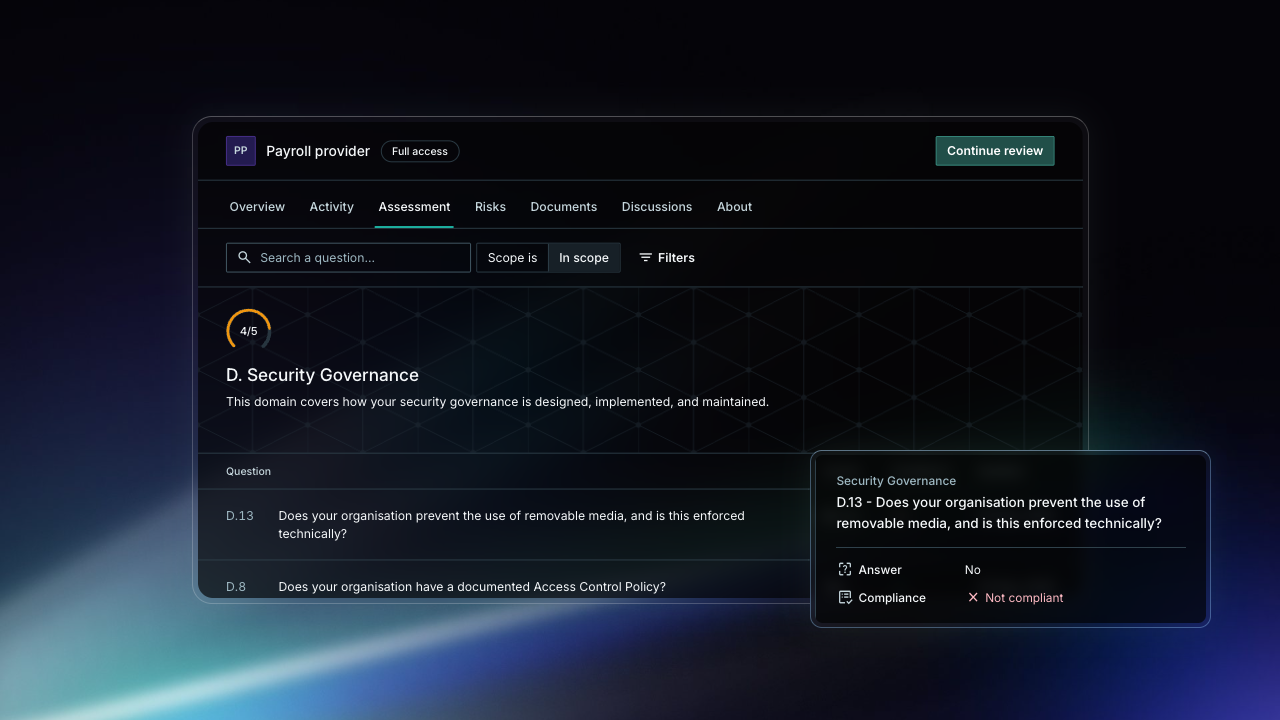
Standardised supplier evidence. All suppliers answer common security assessment based on key regulations and standards, creating a common language of risk for the entire ecosystem. Suppliers then maintain a single, standardised security profile, which they can update and share with all existing and prospective customers, cutting out duplicated assessment time for both. You can also personalise the supplier assessments and requirements to your own unique organisational circumstances.
Alerts to relevant supplier changes. Receive updates to changes in suppliers’ security postures, including when suppliers add new subprocessors or redesign services, so you can review these changes quickly and independently of a full review.
A network view of supplier relationships. By showing all your third, fourth and nth-party relationships on one map, you can see hidden dependencies, identify concentration risks and better understand how a supply chain risk could cascade through the ecosystem. You can make risk-based decisions and take premeditated action to mitigate disruptions.
Emerging threat management. With real-time risk signals, intuitive dashboards and simulated disruptions, you can instantly assess the potential impact of emerging threats (i.e. which critical suppliers or services could be affected) and take the appropriate action.
Direct supplier collaboration. You have a direct dedicated two-way channel to communicate with third parties and fourth-party vendors regarding a specific control or during an incident. The platform also enables you to track risk and remediation workflows (i.e. with notifications when suppliers have remediated a risk) without the manual chasing.
Together, Risk Ledger enhances your supply chain risk intelligence, so even lean teams can act with the speed and effectiveness of larger cyber teams.
What security teams ask next about supply chain cyber security threats
How is supply chain risk intelligence different from TPRM and supply chain risk management?
Supply chain risk intelligence connects the outputs of TPRM, supply chain risk management and threat intelligence so they lead to response decisions.
TPRM assesses and governs third-party suppliers. Supply chain risk management sets the policies, controls and resilience plans that run across the supplier lifecycle. Threat intelligence reports new threats, actors and vulnerabilities. Supply chain risk intelligence adds the supplier, dependency and business context that tells you whether a threat affects you and what to do first.
How does continuous supplier monitoring support supply chain risk intelligence?
Continuous supplier monitoring keeps your supplier picture current between assessments.
It tracks changes to supplier controls, certifications, critical services and dependencies, so a new threat is matched against today's supplier data instead of last year's questionnaire. Each monitored change also needs an owner and a defined next step, or the signal never reaches an investigation or decision.
What data sources are used to assess supplier risk?
No single data source gives a reliable supplier risk picture.
Supply chain risk intelligence combines supplier questionnaires and evidence, internal supplier records, external security monitoring, vulnerability and threat intelligence, dependency data, supplier communications, and incident and remediation records. Each source establishes something the others cannot. External monitoring can show an exposed service, for example, but says nothing about a supplier's internal controls.
What should security teams look for in a supply chain risk intelligence platform?
Look for a platform that combines supplier evidence with external signals, shows fourth-party dependencies and concentration points, and lets you contact suppliers and track their responses.
Check feasibility too, including how much work it asks of suppliers and how much internal resource it takes to run. At a minimum, it should help you answer five questions for any alert.