By clicking “Accept”, you agree to the storing of cookies on your device to enhance site navigation, analyze site usage, and assist in our marketing efforts. View our Privacy Policy for more information.
Supply Chain Cyber Security Threats in 2027: What Security Teams Need to Monitor
The supply chain cyber security threats we’re seeing in 2026, how attacks spread through suppliers, and how to prioritise, monitor and respond.
Risk Ledger
|
Company
November 20, 2026
|
15
mins read
Share
Quick answer
Supply chain cyber security threats are attacks, vulnerabilities and disruptions that reach your organisation through suppliers, subcontractors, software packages and service providers, and their real weight depends on which of your suppliers they touch and what those suppliers support.
Five main routes in. Direct supplier access, subcontractors and fourth parties, shared cloud and SaaS providers, software packages and build pipelines, and trusted identities, APIs and integrations.
Prioritise by criticality, not by headline. Weight the business service a supplier supports, the data and privileged access it holds, how easily it could be replaced and how many other suppliers share the same provider.
Monitoring needs two inputs. External scanning shows exposed services and certificate issues, but only supplier-maintained evidence shows changes to internal controls, subcontractors and incident response.
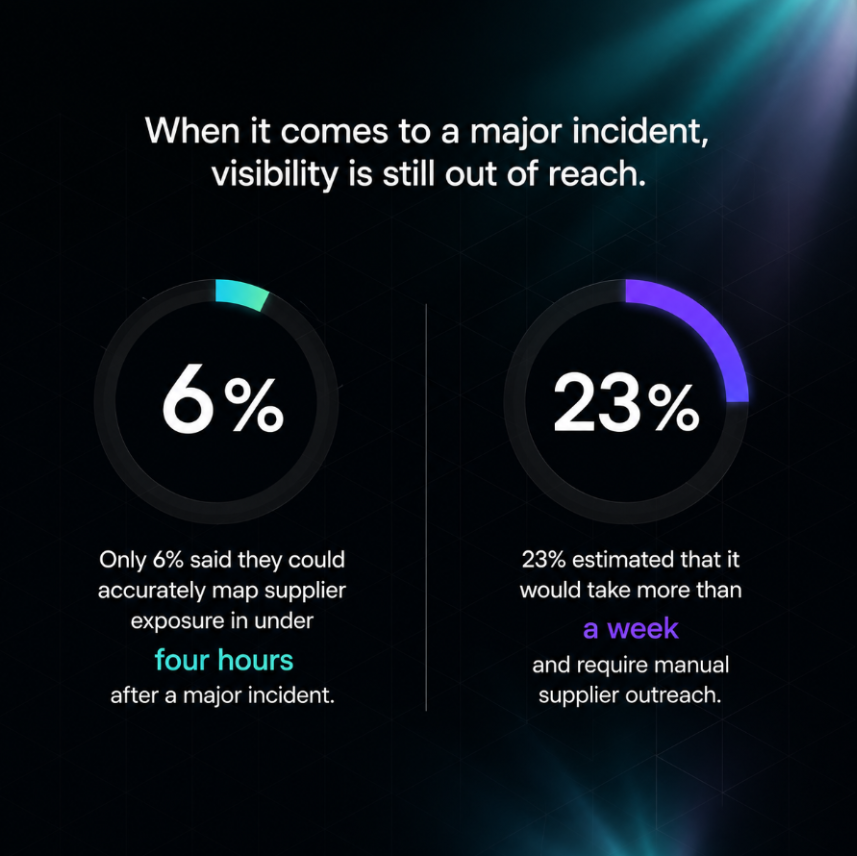
Response speed is set before the incident. Only 6% of security professionals can map supplier exposure within four hours of a major incident, because direct and fourth-party dependencies are rarely mapped in advance.
Reduce exposure up front. Record critical subcontractors, agree incident-notification routes and hold a named security contact at every critical supplier.
MOVEit Transfer in 2023. Snowflake in 2024. Jaguar Land Rover in 2025. In 2026, simply knowing the names or origins of supply chain cyber security threats is not enough. You need to know how these threats spread through your critical suppliers and impact your business operations.
Modern supply chain cyber security threats are attacks, vulnerabilities and disruptions that reach your organisation through suppliers, subcontractors, software packages and service providers. 82.4% of UK cyber security and Third-Party Risk Management (TPRM) professionals experienced at least one of these supply chain incidents in the past 12 months. But not all threats carry the same weight. Their significance depends on which of your suppliers are affected, the business services they support, what data access they hold and how widely the same dependency is shared.
When supply chain threats emerge, you need to quickly assess their blast radius and potential impact to determine your response, but only 6% of cyber professionals can map exposure across their supplier ecosystem in under four hours after a major incident (56% cannot map their exposure within 24 hours). In an era of interconnected supply chains, state-sponsored sabotage and fast-moving digital threats, this has to change.
That’s why this guide will show you how to identify, prioritise, monitor and respond to supply chain security threats, and how to lay the groundwork required to reduce your exposure.
How supply chain cyber threats reach your organisation
We’re long past the age when firewalls, perimeter defences and third-party supplier assessments were enough to prevent cyber incidents impacting your organisation. Nowadays, modern threat actors don’t even need to attack you directly to severely affect your systems, data or services; compromising just one shared dependency deep in the supply chain can cascade to hundreds of downstream organisations.
Today’s supply chain cyber threats come in many shapes and sizes, with each attack, incident or disruption demanding a different response. Here are the five main threat types in 2027.
Direct supplier access
A breach occurs at a directly contracted supplier who has access to your data and systems. Be it through your lawyers, management consultants or payroll software provider, a threat rides the digital highway between your organisations, either impacting you directly (i.e. breaches can expose your customer’s data) or indirectly (i.e. outages at the supplier can make their services unavailable). For instance, the 2025 M&S ransomware attack was perpetrated by cyberattackers breaching Tata Consultancy Services (TCS), the third-party contractor that ran M&S's IT helpdesk, who then used stolen TCS employee credentials to access M&S's network.
To combat these threats, your security team needs: contractual guarantees of supplier security standards and continuous monitoring of your direct suppliers’ security posture.
Subcontractors and fourth parties
An incident occurs at one of your direct supplier's suppliers; a company you have no direct relationship or right to audit. Whether it’s a tech provider outsourcing a contracted service or your HR software’s cloud provider, supply chain incidents striking beyond your direct suppliers have a doubly pernicious effect: you not only struggle to see them (only 30% of companies have full visibility beyond third-parties), but a single supplier compromise can quickly travel through the supply chain to your perimeter. Take the MOVEit Transfer Supply Chain Attack in 2023. Enterprises like British Airways had employee data compromised after their third-party payroll provider, Zellis, was exploited following a breach at the fourth-party software Zellis used to process files, MOVEit Transfer.
To combat these threats, your security team needs: a network view of supply chain connections beyond third parties and regular concentration risk assessments.
Shared SaaS, cloud and managed services
An outsourced operator is compromised and used as a route to many customers at once. If several of your seemingly independent suppliers actually rely on the same cloud provider, managed service or even low-spend SaaS tool, an incident at these single points of failure can disrupt a whole trove of your suppliers at the same time. For example, Collins Aerospace supplies the MUSE check-in software used by multiple European airlines. When that software was attacked, Heathrow, Brussels and Berlin airports were all forced to carry out manual check-in.
To combat these threats, your security team needs: regular audits of shadow IT and cloud application usage, and automated discovery tools to find and evaluate external connections.
Software packages, updates and development pipelines
Modern attackers are increasingly targeting open source packages, developer environments and build pipelines to spread malware. Developers use multiple platforms to create, collaborate and re-use software, thereby creating a complex set of ecosystem dependencies, which are less tightly controlled than corporate environments. Attackers know this, which is why software supply chain compromises are on the rise. In their 2026 report, Sonatype identified a 75% year-on-year increase in new malicious packages across npm, PyPI, Maven Central, NuGet and Hugging Face.
To combat these threats, your security team needs: a real-time software bill of materials (SBOM) for all critical applications and supplier evidence of secure CI/CD practices and rapid patching.
Trusted identities, APIs and integrations
When one of your trusted stack of APIs, identities and integrations adds a new technology partner or subprocessor, you inherit the supply chain risk. Even if you review all your integrations, a supplier can subsequently send data to processors that were not visible during the initial review, creating a new data flow for a supply chain threat. This is happening increasingly frequently in the AI era, with third-party engineers introducing API connections to fourth-party AI providers without even their security team knowing about it, let alone yours. In August 2026, for example, a hack at open-source AI proxy LiteLLM hack, led to 153GB being stolen from their CI/CD pipeline, affecting 2,500 organisations.
To combat these threats, your security team needs: alerts to supplier agreements with new subcontractors and ability to raise concerns directly with their security team.
The supply chain cyber threats security teams should prioritise in 2027
We often get asked about the ‘top risks’ that supply chain security teams should focus on. But what counts as a top priority to one company is likely to be different to another.
That being said, there are some common supply chain cyber threats that require security team attention no matter your size or resources. These include:
Compromised supplier identities and privileged access. Where an attacker breaches one of your suppliers and uses its access to reach your customers through stolen credentials, compromised support accounts, service accounts and abused remote access. E.g. Hackers stealing the 1.3TB of Ticketmaster users’ personal data.
Software supply chain compromise. Where attackers insert malware into a software package, tamper with an update or poison a build system before it reaches you. E.g. Supply chain attacks involving malicious npm packages.
Ransomware and destructive attacks against critical suppliers. Where one of your suppliers suffers an attack that disrupts their service or exposes their customers data without necessarily breaching you directly, but still impacting your operations. E.g. The ransomware attack on Synnovis leading to 11,000+ cancelled NHS appointments.
These eight common risks are amplified when you have limited visibility or your ability to respond to incidents is hampered. You should treat them as higher priorities if any of the following risk amplifiers are present during these threat situations.
Risk amplifiers
When to treat a supply chain threat as a higher priority
Raise the priority of any of the eight threats above if one or more of these conditions applies.
Amplifier
Applies if
Excessive supplier access
The supplier has full access to your data and systems, including customer data.
Unknown fourth parties
You cannot see which underlying fourth-party supplier underpins many of your third-party suppliers.
Shared providers
Many of your critical suppliers rely on the same shared tech provider for their critical services.
No viable alternative supplier
You rely on specialist or industry-specific technical software that is not easy to replace.
Outdated supplier evidence
You receive security evidence periodically (e.g. annually) rather than continuously.
Weak supplier communication
You don't have a named contact or channel to the security team at each critical supplier.
Unclear ownership
Responsibility for maintaining supplier lists and monitoring supplier security is split (e.g. between InfoSec and Procurement).
Why the same incidents create wider business impact
According to the WEF Global Cybersecurity Outlook 2026, 65% of large organisations consider supply chain vulnerabilities their greatest cyber challenge, up from 54% the year before. Why?
First, it’s the increasing prevalence of supply chain threats. From state-sponsored sabotage and AI-powered attackers to hidden concentration risks and fourth-party vulnerabilities, today’s organisations are faced with what Dr Richard Horne, CEO of the National Cyber Security Centre, calls the “perfect storm”.
Second, it’s the increasing impact these supply chain incidents are having as business operations become reliant on intertwined digital connections and service providers. In particular:
More critical services now depend on suppliers
How many services does your organisation outsource? It’s likely you rely on an interconnected stack of APIs, cloud providers, and managed services to deliver your critical services with everything from app availability and customer access to payments and identity management now being provided by external suppliers. If a direct supplier suffers an incident, their service is interrupted. If the fourth-party supplier that 10 of your direct suppliers rely on goes down, then the impact magnifies, potentially derailing your entire business operations.
Several suppliers may depend on the same provider
What might appear a low risk dependency can become increasingly significant depending on how many suppliers this shared provider supports. In financial services, for example, AWS, Azure and GCP serve more than 80% of the industry. Any issue at one will cascade to downstream organisations, whether they know about the concentration risk or not (70% of organisations cannot identify concentration risks among deeper-tier providers).
Software dependencies are deeper than most supplier registers show
The third-party software you assessed during contracting may actually depend on open-source packages, build tools or hosting providers that are not visible in a direct contract. Although you have no direct connection with these platforms, you inherit the operational and cyber exposure from a third-party supplier whose devs use those platforms. What’s more, the deeper the nth-party dependency, the lower the visibility with 50.2% of organisations claiming high visibility over their critical fourth parties, but just 30% claiming full visibility of critical nth-party connections.
AI adoption is creating new dependencies
Yes, attackers might use AI to find vulnerabilities more quickly, but the greater supply chain threat actually comes from third-party engineers using AI tooling. Rapid AI adoption has led to a growing dependence on a small group of foundational technology providers, such as Anthropic or OpenAI, which means you're now exposed to AI model choices made by third-parties. What’s more, their engineers may simply plug in AI tools to their existing tech stack a few months after you’ve contracted, sending your confidential data into an LLM at the fourth-party layer, which is incredibly difficult to monitor.
How third-party, fourth-party and concentration risks differ
How you approach each of these supply chain security threats depends on your visibility of them and the contractual obligations you have at your disposal. This varies depending on your relationship to the risk.
Third-party risk: Focuses on your directly contracted suppliers. As you have a direct contractual relationship, you can assess their security before onboarding and continuously monitor emerging risks through supplier updates.
Fourth-party risk: Focuses on your suppliers’ suppliers. With no direct connection, you lack the contractual control to perform security due diligence or monitor their changing security posture and rely on supply chain risk intelligence tools to view connections and pinpoint concentration risks.
Concentration risk: Focuses on situations where one supplier can become a single point of failure - either when you depend too heavily on a supplier to deliver multiple critical services or when multiple suppliers are resting on the same underlying connection. To effectively identify, monitor and mitigate concentration risks, you need live supply chain mapping, not static suppliers lists.
Comparison
Third-party, fourth-party and concentration risk compared
Risk type
Relationship
Contractual control
Typical visibility
Main concern
Practical response
Third-party risk
Direct supplier
Direct
Contract, register and assessment
Controls, data, access and service continuity
Direct assurance and monitoring
Fourth-party risk
Supplier's supplier
Indirect
Often limited or indirect
Hidden dependency and delayed communication
Dependency mapping and supplier escalation
Concentration risk
Shared provider across relationships
Varies
Difficult to see from one supplier record
Cascading impact and common failure point
Portfolio and network analysis
Practical decision rule
Where you hold the contract, assure the supplier directly. Where you don't, map the dependency and escalate through the supplier who does. Where the same provider sits behind several suppliers, assess it across your whole portfolio, because no single supplier record will show it.
Which suppliers and dependencies should be prioritised first?
When a supply chain security threat emerges, you cannot investigate every affected supplier to the same degree - nor should you.
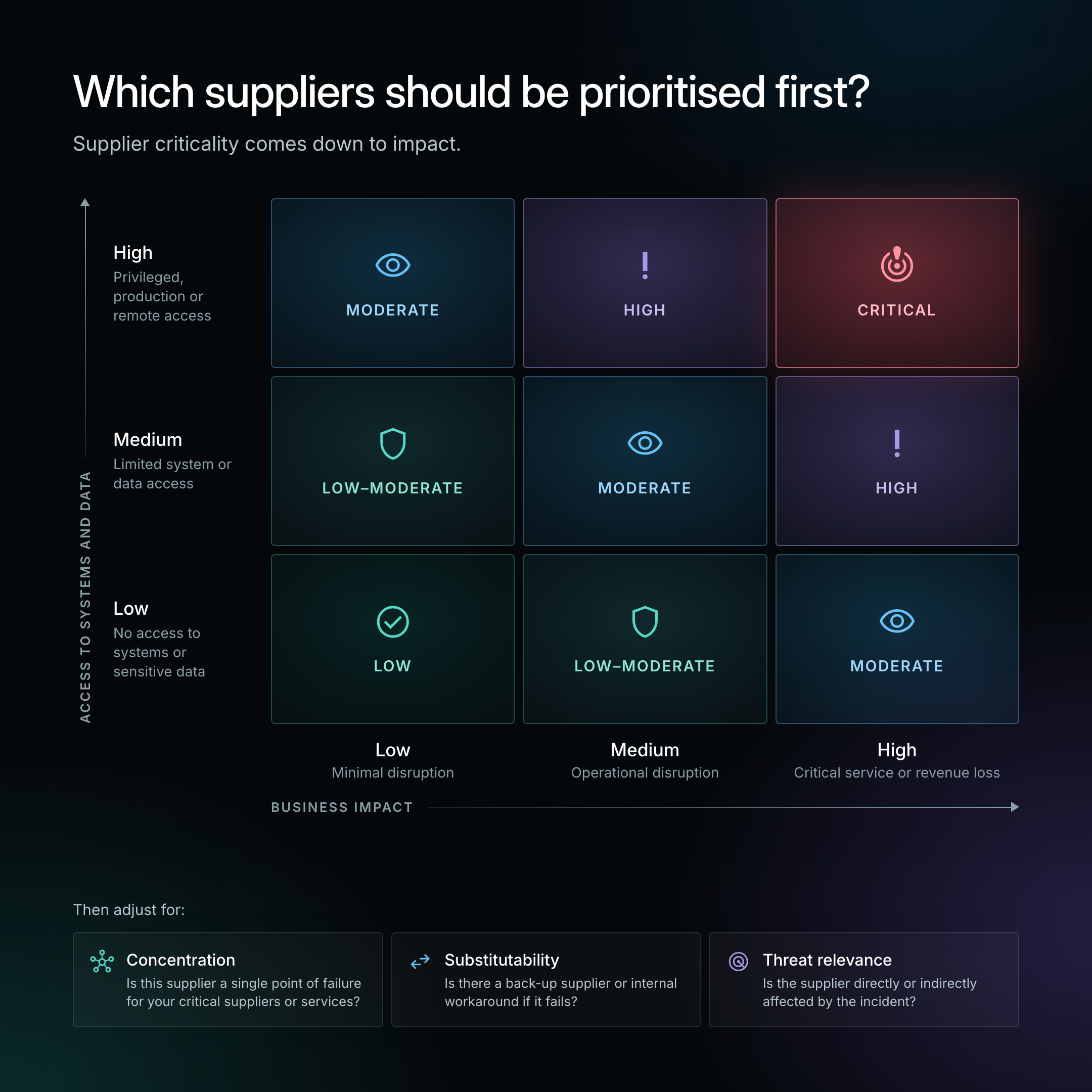
Your focus depends on whether an affected supplier underpins one of your critical business functions, holds system access or sensitive data, or would be difficult to replace. Or, in other words, the supplier’s criticality.
Supplier criticality is inherently subjective. Regulators, such DORA’s Critical ICT Third-Party Providers and FCA’s Critical Third Parties (CTP) regime, define ‘criticality’ as providers whose failure could lead to severe disruption (e.g. the major cloud providers Microsoft, Google, AWS and Oracle were designated as critical by the UK Government in June 2026).
But, at an organisational level, criticality comes down to impact. For a private sector organisation, this is usually revenue impact. How much will it cost if some of your services go down? M&S saw a 55.4% fall in H1 pre-tax profits after its supply chain breach. Jaguar Land Rover posted a quarterly loss of £485 million. These are the types of threats to prioritise.
To determine your supplier criticality, we recommend prioritising dependencies based on:
Importance of the business service supported: How will you be able to function if the supplier goes offline?
Data sensitivity and volume: Are you at risk of regulatory non-compliance if the data held by this supplier is compromised?
Privileged, production or remote access: Could a cyberattacker get privileged access to your systems or customer data if they steal the supplier’s credentials?
Operational dependency: Is the supplier essential to your operations in a particular industry or geographic context?
Recovery-time requirements: How long would it take to recover from this supplier being unavailable and what is the financial cost of this time?
Substitutability and available workarounds: Are there other external suppliers or internal mechanisms you can use as a back-up or failover if the supplier fails?
Fourth-party dependencies: How many of your critical service relationships are tied to the functioning of this supplier?
Concentration across services or suppliers: Is this supplier a potential single point of failure for lots of your critical suppliers or services?
Relevance to the active threat: Is the supplier directly or indirectly affected by the incident?
Freshness and confidence of existing evidence: Is your supplier information derived from continuous monitoring or periodic assessments?
Quality of supplier security contacts: Do you have a named person, phone and email at the supplier or just a contact page?
Previous unresolved findings or remediation: Did the supplier ignore, forget or take a long time to remediate their last issues?
By weighting each of these different criteria according to your risk appetite, you will be able to rank suppliers by criticality and thus determine which to address in case of a supply chain security threat. For instance, you may be willing to risk a £100,000 revenue loss per day if the time and cost of switching suppliers far exceeds this figure. Whereas, a moderately secure supplier supporting a critical service with privileged access and no viable substitute may deserve faster action than a lower-scoring supplier with little business impact.
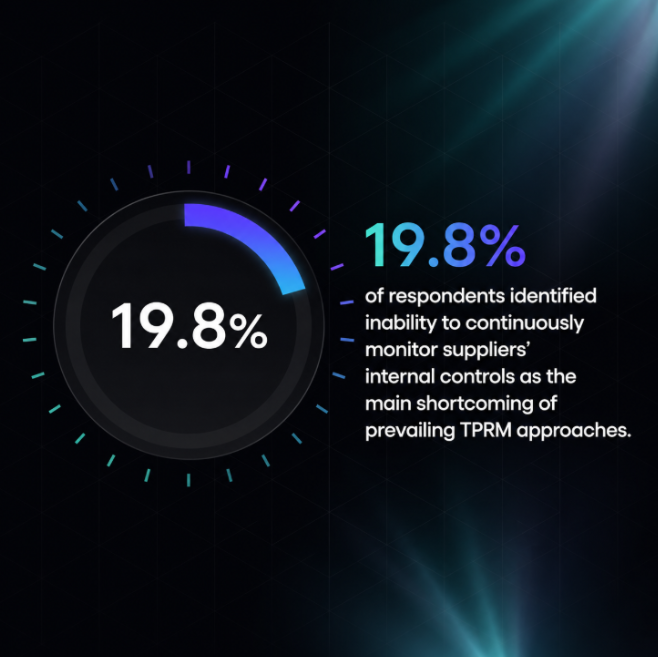
In today's fast-moving, interconnected supplier ecosystem, you can’t wait months to find out about a vulnerability from a periodic supplier assessment. Yet, only 40.6% of organisations have fully automated, real-time monitoring of their critical suppliers' internal security controls; the majority still rely on quarterly or annual reviews.
There is growing appetite to move to ‘continuous supplier monitoring’, but there is a lack of consensus on what this entails. For instance, some believe external vulnerability scanning counts as ‘continuous monitoring,’ but this only highlights exposed ports and expired certificates, and doesn’t say anything about the supplier's internal access controls or incident response capability.
True continuous monitoring combines both external signals and internal security controls, providing real-time updates and control-level change notifications. Here are the key inputs to look for:
Continuous monitoring
What continuous supplier monitoring should cover
Effective monitoring combines supplier-maintained evidence with external signals, so you see changes to internal controls as well as exposed infrastructure.
Monitoring capability
Key focus
Supplier-maintained evidence
Changes to controls, policies, certifications and product-level information.
Evidence freshness
Expired documents, overdue reassessments, unresolved exemptions and out-of-date contacts.
External technical signals
Exposed services, asset changes, leaked credentials, certificate issues and known vulnerabilities.
Business and dependency changes
Acquisitions, agreements with new subcontractors, service redesigns and new shared providers.
Emerging-threat intelligence
Threats matched to the suppliers, products, software and services you actually use.
Incident and breach notifications
Direct supplier communication, supported by named contacts and agreed escalation routes.
Remediation progress
Whether agreed actions were completed, delayed or accepted as residual risk.
But remember: monitoring alone is only half of the battle. Every risk signal should lead to tangible actions and outcomes, such as a review, escalation, remediation, acceptance or incident response.
How to respond when a new supply chain threat emerges
Every supply chain threat is entirely different. You can’t run through the same incident response playbook every time a new vulnerability is released. Nor can you simply add it to your to-do list as it may require immediate prioritisation.
As you’re unaware of its potential significance when you first learn of a new threat, speed is of the essence. You need to have the processes in place to quickly understand your exposure and roll out your incident response plan.
We recommend following this 10-step process for every new threat.
Validate the advisory, vulnerability or incident. You don't want to start spinning up an incident response plan for something that's not active, so double check the vulnerability by looking at trustworthy sources, such as the NCSC, NSA or CISA. In addition, see if the vulnerability has been given a CVE score by NIST or MITRE (a score above 9.8 tends to warrant attention, but the score on its own doesn't tell you how it impacts your organisation).
Identify direct use of the affected supplier, product or service. After verification, check your own direct exposure. This should take no more than a few hours as you have all the information sitting internally in your supplier database or map. If you have a direct contractual relationship with the affected supplier, note whether the supplier is critical (i.e. in terms of data access, business services supported or substitutability).
Check indirect and fourth-party use. Review the deeper tier connections of your suppliers to determine which of them have an indirect fourth party connection with an affected organisation and what your potential exposure is in terms of these other suppliers going offline. Use your network map to trace the connections or, if you don’t have mapping, reach out to all your affected suppliers to verify the fourth-party link.
Map affected suppliers to critical business services. If you have supplier mapping, determine which of the affected suppliers are critical to your business functions and which are minor disruptions. This will help show your true exposure. If that mapping doesn't already exist, your only option is to send an email to the whole supplier database.
Prioritise by impact, access, concentration and substitutability. Before you escalate, you need to narrow your focus. To help you prioritise action, evaluate the criticality criteria by high-to-low priority, such as: the impact of the business service going down, level of privileged access held, the breadth of the concentration risks and the ease of replacing the supplier.
Contact relevant suppliers with targeted questions. Start by contacting the suppliers that are most critical to you and focusing on their replies first. To help you better understand your exposure and triage the right response, ask the following questions:
Do you use the affected product, component or service?
Which versions, environments or services are affected?
Is exploitation confirmed, suspected or ruled out?
Which customer data, systems or services could be affected?
What containment and remediation actions have been completed?
Are any subcontractors involved?
When will the next update be provided?
Decide containment, mitigation or workaround actions. Now is the time to revert to your incident playbook with your actions based on impact criteria. For example, if Gong goes down and you can’t record calls, you could switch suppliers using your pre-selected failover or bring out a paper and pencil. But if your whole online operations are going to be affected, you might have to spin up backup systems, call in your legal teams and prepare a response to shareholders. For all response plans, the key is to make sure you maintain at least a minimal viable business.
Brief leadership using confirmed facts, assumptions and open questions. No CISO wants to confront the C-suite and/or board with outdated data or unconfirmed reports. Leadership needs clarity on what's affected, what's ruled out, what's unknown, what's being done and what could happen next. So pull up real-time data from continuous monitoring reports and use network visualisations to show them the blast radius of the threat, how it impacts you and how your affected suppliers are responding.
Record residual risk and remediation deadlines. For those affected suppliers, set up the timelines to respond and ask for proof they’ve remediated the issue. Ideally, this would involve clear threat-specific updates without having to chase emails or lots of manual back and forth, such as having a dedicated channel or platform.
Review lessons learned and update supplier requirements. Even if it's a minor threat with minimal impact, make sure to review your incident response, heed the lessons and update your supplier policies accordingly. For example, you might realise you did not have direct relationships with the security teams at all your critical suppliers (55.4% of UK don’t) and you need to get named contacts before the next incident.
How to reduce exposure to supply chain cyber threats
The UK Government's Cyber Security Breaches Survey 2025/2026 found that just 15% of businesses formally review the cyber risk posed by their immediate suppliers and only 6% review their wider supply chain. This is a huge gap that can be addressed by taking proactive measures.
Although not every supplier incident can be prevented, you can introduce controls and processes that reduce your exposure to supply chain security threats and improve your incident response. Complete this checklist to make sure that supplier criticality, contact routes and relationship ownership are established (and verified) before a threat appears.
Checklist
Supply chain threat readiness checklist
Confirm supplier criticality, contact routes and ownership before a threat appears, not during the incident.
01Before onboarding
02During the relationship
03For software suppliers
04For critical suppliers
How Risk Ledger supports supply chain threat monitoring and response
Having the supply chain risk intelligence to instantly assess and respond to threats requires a collective effort. That’s why Risk Ledger is pioneering a network-first approach to supply chain risk management.
Our connected network approach brings organisations and suppliers together on the same platform, highlighting third, fourth and nth-party connections on a live ecosystem map, so you can instantly visualise your exposure when threats emerge. What’s more, you can quickly bulk‑contact all organisations on the network to ascertain whether they are affected and track how they are responding. This significantly cuts incident triage time from days to hours and allows for a coordinated network‑level response.
In particular, Risk Ledger enables you to:
Collect comparable supplier information through a standardised assessment: All suppliers answer common security assessment based on key regulations and standards, creating a common language of risk for the entire ecosystem.
Allow suppliers to maintain and reuse evidence: Suppliers maintain a single, standardised security profile, which they can update and share with all existing and prospective customers, cutting out duplicated assessment time for both.
Apply your own policies, criticality and risk appetite.:Personalise the supplier assessments and requirements to your own unique organisational circumstances.
Review relevant supplier changes without rebuilding the record: Receive updates to changes in security posture, including when suppliers add new subprocessors or redesign services, so you can review these changes quickly and independently of a full review.
See important nth-party relationships and shared dependencies: By showing all your third, fourth and nth-party relationships on one map, you can see hidden dependencies, identify single points of failure and better understand how supplier disruptions cascade through the ecosystem.
Investigate concentration risk: With a bird's-eye view of your entire network’s changing concentration risks, you can make risk-based decisions and take premeditated action to mitigate disruptions.
Overlay emerging threats against connected supplier relationships: With real-time risk signals, intuitive dashboards and simulated disruptions, you can instantly assess the impact of emerging threats and take the appropriate action.
Work directly with suppliers on evidence, exposure and remediation: You have a direct dedicated two-way channel to communicate with third parties and fourth-party vendors regarding a specific control or during an incident.
What security teams ask next about supply chain cyber security threats
How do we know whether a new supply chain threat affects us or our suppliers?
Start with direct exposure. Cross-reference the affected supplier, product or service against your supplier database or map to see whether you use it yourself.
Then check indirect exposure by finding which of your suppliers have a fourth-party connection to the affected organisation. A network map lets you trace those links quickly. Without one, you'll need to contact your suppliers to confirm whether the fourth-party link exists.
Which suppliers should we contact and prioritise first during an incident?
Contact your critical suppliers first: those that underpin critical services, hold system access or sensitive data, and would be difficult to replace. To rank supplier criticality, weigh:
Importance of the business service supported
Data sensitivity and volume
Privileged, production or remote access
Operational dependency
Recovery-time requirements
Substitutability and available workarounds
Fourth-party dependencies
Concentration across services or suppliers
Relevance to the active threat
Freshness and confidence of existing evidence
Quality of supplier security contacts
Previous unresolved findings or remediation
How often should critical suppliers be reassessed, and what should be monitored between reviews?
Reassess critical suppliers on your scheduled cycle and again after any material event, such as an incident, an acquisition or a new subcontractor. A periodic assessment on its own leaves months in which a supplier's posture can change unseen.
Between reviews, monitor both external signals and changes to internal security controls, including business and dependency changes, emerging-threat intelligence, incident and breach notifications, and remediation progress.
How do we identify fourth-party and concentration risk when we do not have a direct contract?
Without a contract, you can't run due diligence on a fourth party or monitor its security posture directly. Supply chain risk intelligence tools fill that gap by showing the connections between your third parties and their suppliers, which is where concentration risk becomes visible.
Concentration risk shifts as suppliers add and change providers, so it needs live supply chain mapping. A static supplier list will miss it.
What information should we ask suppliers for after a vulnerability, breach or service outage?
Ask your most critical suppliers these questions:
Do you use the affected product, component or service?
Which versions, environments or services are affected?
Is exploitation confirmed, suspected or ruled out?
Which customer data, systems or services could be affected?
What containment and remediation actions have been completed?