By clicking “Accept”, you agree to the storing of cookies on your device to enhance site navigation, analyze site usage, and assist in our marketing efforts. View our Privacy Policy for more information.
TPRM Solutions for Financial Services: 2026 UK Comparison
Compare 9 TPRM solutions for UK financial services on supplier participation, nth-party visibility and ongoing assurance, with G2 and Gartner review data.
Risk Ledger
|
Company
September 28, 2026
|
17
mins read
Share
Quick answer
For many UK financial services teams, the hardest TPRM problems are getting suppliers to respond and seeing the dependencies behind critical suppliers, which is where a network-led platform such as Risk Ledger fits best.
With Risk Ledger, suppliers join free and maintain one profile that every connected client reuses, which cuts repeat questionnaires and chasing.
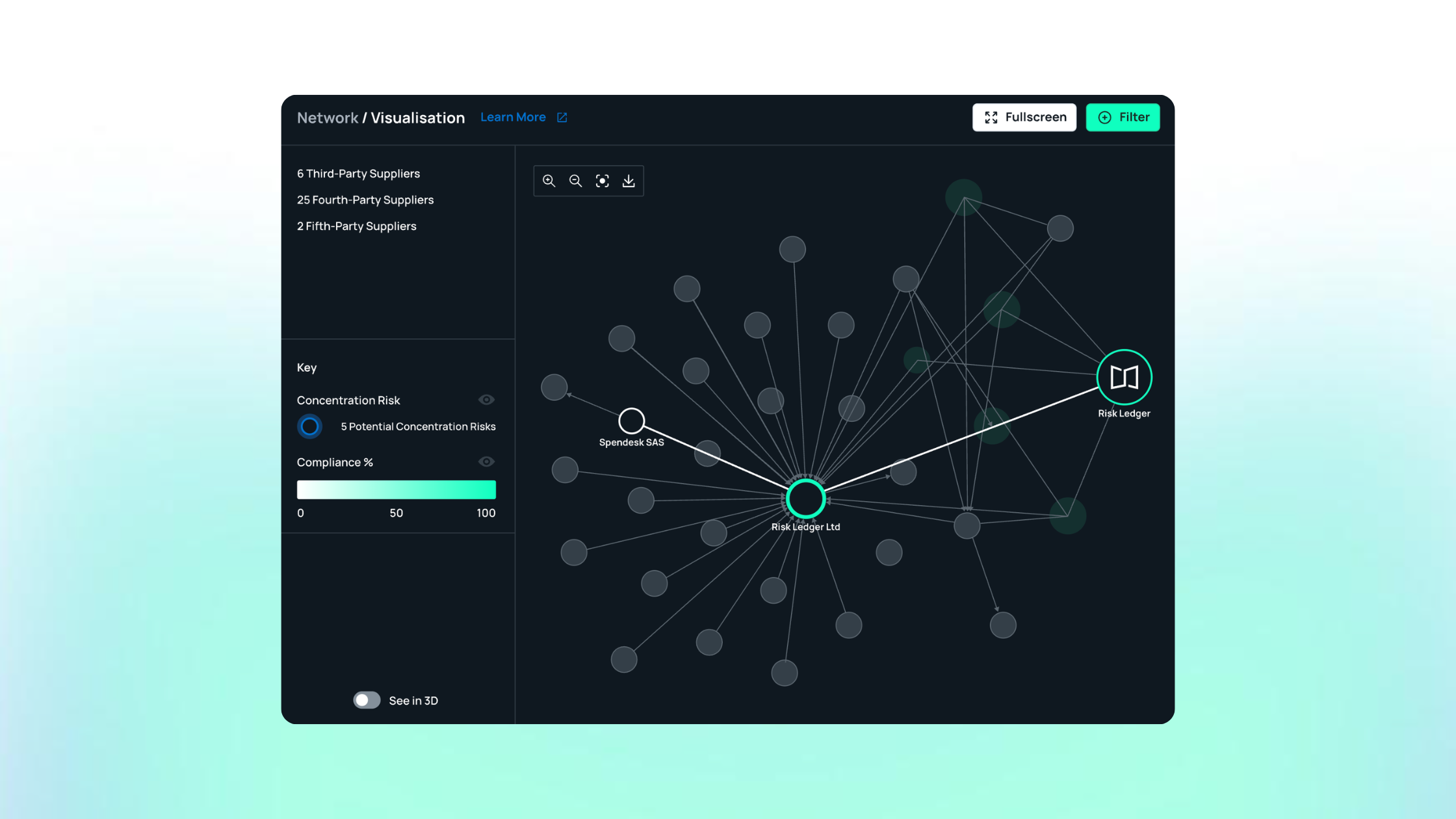
Shared dependencies surface from real connections across 19,000+ organisations, giving firms a starting point for the supply chain view the FCA and PRA reporting rules ask for from 18 March 2027.
When a new threat is published, one question goes to relevant suppliers and each answer reaches every connected client, so exposure is clear faster.
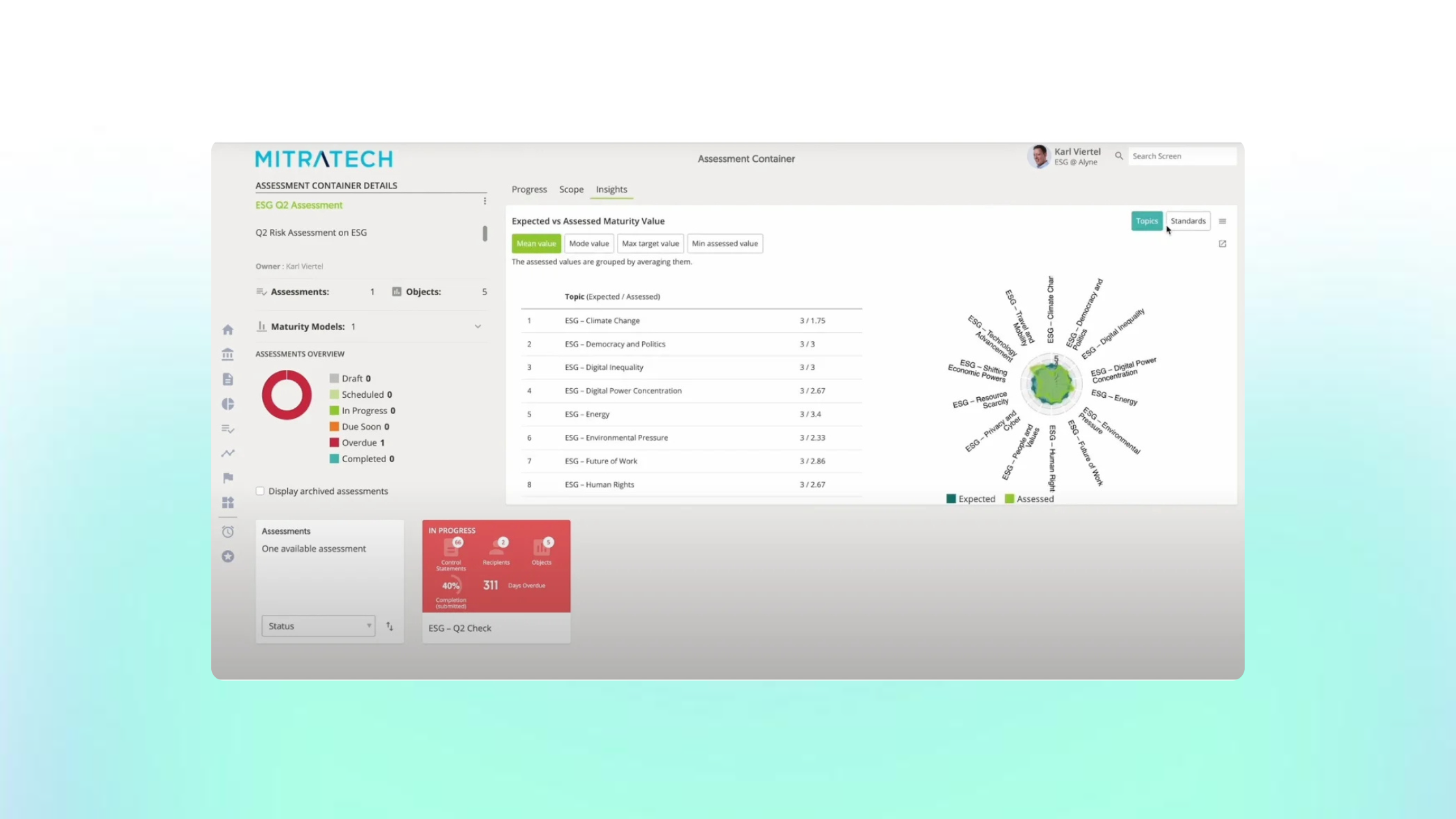
Enterprise suites such as ProcessUnity, Aravo and Mitratech Prevalent suit heavily configured or outsourced programmes.
Ratings tools such as BitSight and SecurityScorecard suit outside-in coverage without supplier participation, and GRC tools such as OneTrust suit consolidation into an existing compliance estate.
The platforms UK financial services teams most often compare fall into five market types:
Network-led TPRM
Enterprise TPRM suites
Security ratings
Combined scanning and questionnaire tools
GRC tools
All of these start from a different source of supplier evidence. And that source decides most of what a platform can and can't tell you.
A security rating is built from what an external scan can observe about a supplier's internet-facing estate. It needs no cooperation from the supplier, which is why ratings platforms can cover thousands of suppliers quickly.
A questionnaire-led platform collects what the supplier tells each client, usually once a year and usually in that client's own format.
A network-led platform starts with a profile the supplier maintains once and shares with every connected client, so the evidence is reused rather than re-collected. These models also differ on dependencies.
A rating can infer that two organisations are related from observable data. A network can show the relationship because both organisations are connected on it.
For a firm trying to work out how many of its critical suppliers rely on the same cloud or software provider, that difference in data source matters more than any single feature.
Note: Managed assessment services, industry schemes such as Hellios FSQS and spreadsheet-based programmes work differently from software platforms and suit different situations.
What to evaluate in a TPRM solution for financial services
Most TPRM platforms now handle questionnaires, supplier inventories, risk scoring and reporting. For UK financial services firms, the more useful differences show up in three harder problems: seeing beyond direct suppliers, getting suppliers to take part, and keeping assurance current between assessments. We've compared every platform in this guide against those three.
Seeing beyond direct suppliers
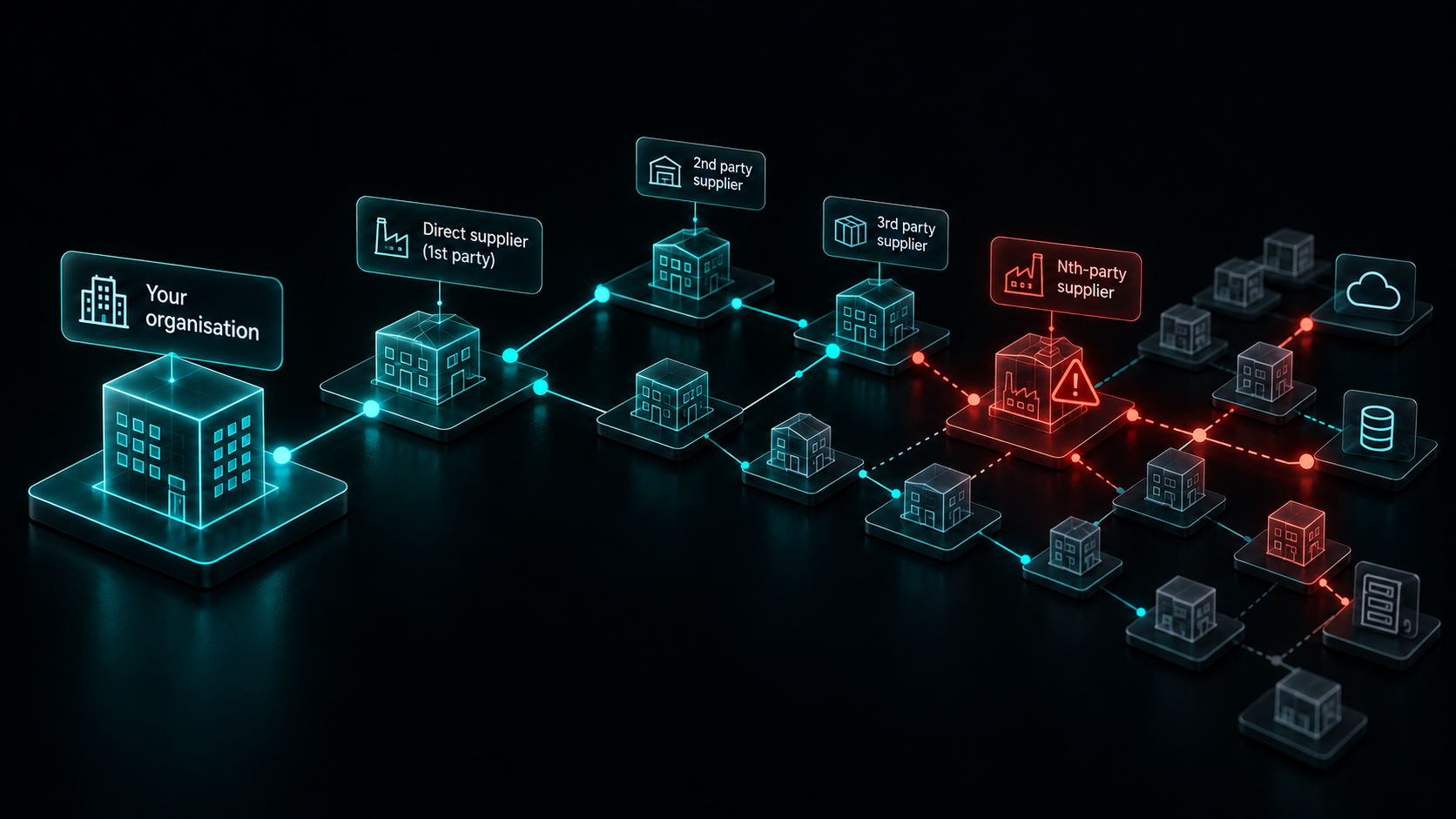
Seeing beyond direct suppliers means knowing which providers your suppliers rely on, and where several of your critical suppliers share the same one. A supplier register shows who you contract with. It doesn't show whether your payments processor, CRM supplier and contact centre all run on the same cloud platform.
FCA, PRA and Bank of England rules on operational incident and third-party reporting apply from 18 March 2027. Firms in scope must notify the regulators of new material third-party arrangements and significant changes to existing ones, and submit an annual register.
The definition covers both outsourcing and non-outsourcing arrangements. The FCA has also kept the requirement for firms to look down their supply chain as part of that register. Its stated aim is to understand how interconnected the industry has become, so it can identify and address systemic risk.
For platform selection, this turns dependency data into reporting input. A tool that holds last year's questionnaire answers for direct suppliers covers part of the register. A tool that shows which suppliers sit behind which services, and who those suppliers rely on, covers the part that is hardest to assemble from spreadsheets.
The regulators' view of concentration is visible in a separate regime. In July 2026 they began overseeing Amazon Web Services, Google Cloud, Microsoft and Oracle as designated critical third parties, because a disruption at any one of them could affect many firms at once. That oversight applies to the providers and the systemic services they supply to the sector - it doesn't show a firm which of its own suppliers depend on them.
“
You have one company who might be deemed as low risk, but actually
they're super critical to a bunch of banks, which on an aggregate layer
means they're a much higher risk than people may perceive.
Haydn BrooksCEO, Risk Ledger
Groups with EU-regulated entities also fall under DORA, which requires a register of information on ICT third-party arrangements. Our DORA compliance checklist covers what that involves.
Getting suppliers to take part
Supplier participation means whether suppliers provide, and keep providing, the evidence you ask for. The common blockers include:
suppliers who don't respond
contacts that are missing or out of date
large vendors who refuse bespoke questionnaires
repeated requests for information a supplier has already given other clients
Platforms tackle this differently. Some automate invitations and reminders, some remove the need for participation by scoring suppliers from outside, and some give suppliers one reusable profile to share. No model removes chasing entirely, and some large suppliers will still decline any platform-based assessment. What's worth comparing is how much repeated work the model takes off both sides.
Keeping assurance current between assessments
Keeping assurance current means knowing what has changed about a supplier since its last formal review. It matters more under the 2027 rules, because firms must tell regulators about significant changes to material arrangements, not just record them at renewal. External scanning picks up some changes quickly, but it can't see internal controls or confirm whether an asset supports the service you use. Supplier assessments give that context, but they go stale without maintenance. The strongest setups combine the two and add a way to question suppliers quickly when a new threat is published.
Three problems compared
How each type of TPRM solution handles the three harder problems
How TPRM solution types handle dependencies, supplier participation and ongoing assurance
Solution type
Seeing beyond direct suppliers
Getting suppliers to take part
Keeping assurance current
Network-led TPRM
Dependencies surface from real connections between organisations and from suppliers naming their critical third parties
One reusable profile is shared with every connected client, so suppliers aren't asked the same questions repeatedly
Supplier-maintained profiles, plus one coordinated question to relevant suppliers when a threat is published
Enterprise TPRM suites
Fourth-party records mapped by the client, sometimes enriched with external data feeds
Automated invitations and reminders; some add shared exchanges or managed chasing
Scheduled reassessment and remediation tracking, with optional monitoring feeds
Security ratings
Relationships inferred from external signals, fast and broad but in need of validation
Not needed for a score, though suppliers are still needed to validate findings
Continuous external monitoring, with no view of internal controls
Combined scanning and questionnaire tools
Fourth-party detection from external data
Client-issued questionnaires, completed per request
External signals between questionnaire cycles
GRC tools
Centred on direct relationships; fourth- and nth-party linking varies by product
Configurable assessment workflows run by each client
Scheduled reviews, evidence storage and issue governance
How we compared. Review data comes from G2 and Gartner Peer Insights, checked in September 2026, and was compared against each vendor's own documentation. Where we cite a reviewer, the theme recurs across several reviews. Risk Ledger is one of the nine platforms compared, and we applied the same standard to our own profile.
TPRM solutions for financial services compared
TPRM solutions for financial services
Nine TPRM platforms compared for UK financial services
Compare how each platform handles the three problems that separate TPRM solutions for UK banks, insurers, asset managers and payment firms: seeing beyond direct suppliers, getting suppliers to take part, and keeping assurance current.
How we compared: Drawn from current G2 and Gartner Peer Insights review data for each platform, checked against each vendor's own documentation. Review data last checked September 2026.
Risk Ledger
Network-first TPRM
Risk Ledger comparison
Best for
Reusable supplier evidence and visibility of shared dependencies behind critical suppliers
Primary approach
A connected network of 19,000+ organisations where each supplier maintains one security profile and every client applies its own policies, tiering and risk appetite on top of it.
Supplier evidence
One assessment against a standardised control framework, maintained by the supplier and reused across every connected client, so evidence stays comparable from one supplier to the next.
Beyond direct suppliers
Dependencies surface from real connections, since many suppliers are also clients assessing their own suppliers on the same network. Suppliers also name their own critical third parties within the assessment.
Supplier participation
Free for suppliers to join and maintain a profile, which removes a common reason for non-response.
Ongoing assurance
Tracks changes to supplier controls and evidence over time. When an emerging threat is published, a standard question goes to relevant suppliers and each answer reaches every connected client.
Operating effort
Cuts repeated collection and supplier chasing. Rated 4.4/5 from 126 reviews on G2; one Gartner Peer Insights reviewer wanted more flexibility in the questions they could ask.
Key consideration
Not a GRC suite or a managed assessment service, and external scanning is narrower than a dedicated ratings platform. Strongest where the job is supplier assurance and dependency visibility.
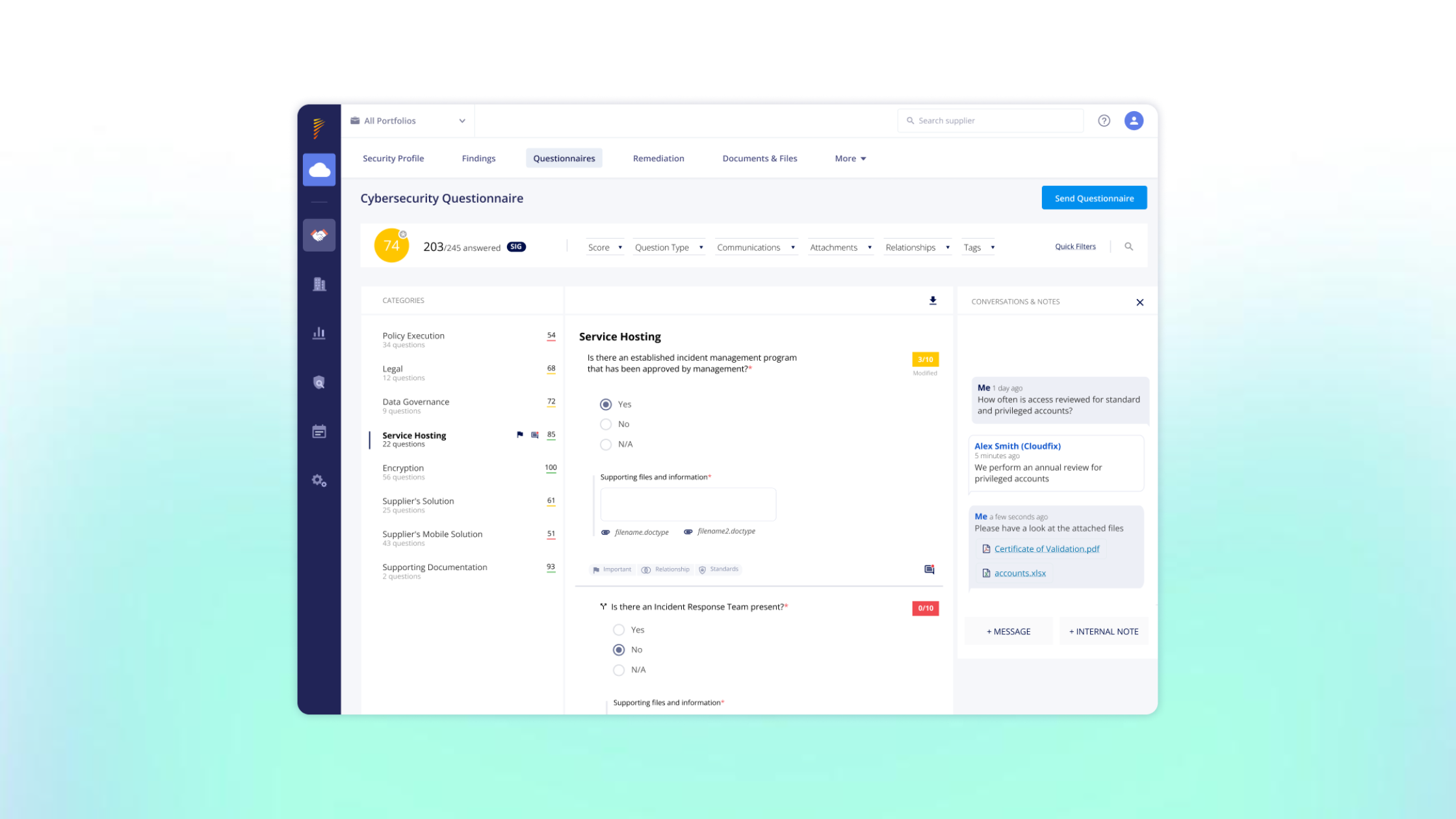
ProcessUnity
Configurable enterprise TPRM
ProcessUnity comparison
Best for
Mature programmes with dedicated TPRM staff that need deep configuration
Primary approach
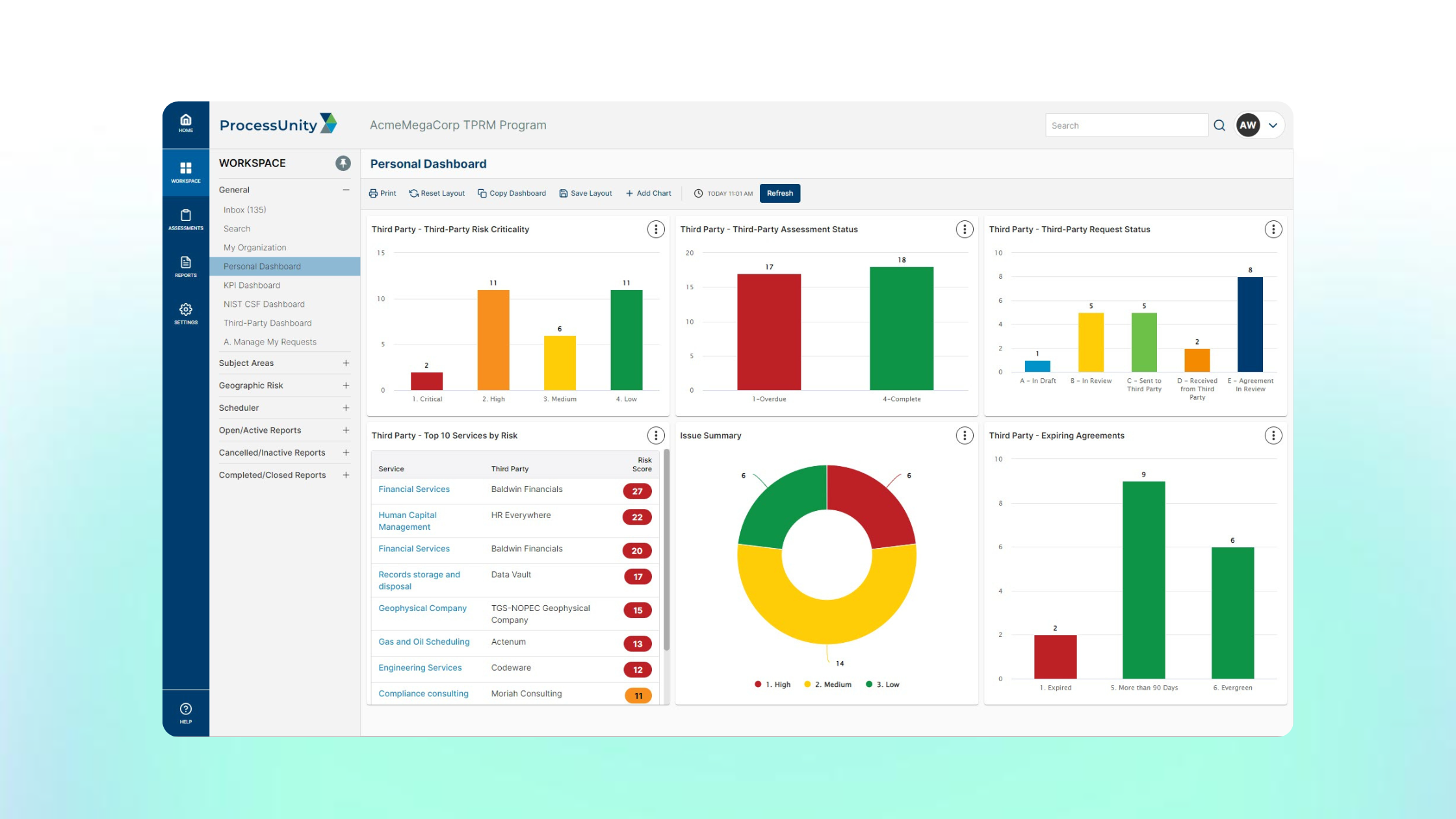
Configurable lifecycle workflows built for third-party risk, with a shared risk data exchange that gives early visibility of a vendor before a full assessment completes.
Supplier evidence
Client-led assessments collected through a vendor portal, with exchange data reducing some duplicated assessment work.
Beyond direct suppliers
Fourth-party mapping sits alongside exchange data, which works as a shared data pool rather than a profile each supplier owns and keeps current.
Supplier participation
Vendors submit evidence through a dedicated portal. One G2 reviewer found vendor contact management difficult where a single vendor has several contacts.
Ongoing assurance
A threat and vulnerability response module links external intelligence to fourth-party mapping.
Operating effort
G2 reviewers note configuration changes need careful planning, and advanced reporting can depend on specialist administrators. Support quality is consistently praised.
Key consideration
Actively tracking the PRA and FCA third-party rules that apply from March 2027, and best suited to teams with the admin capacity to run a highly configurable tool.
Aravo
Multi-domain enterprise TPRM
Aravo comparison
Best for
Global enterprises running cyber, privacy, anti-bribery and ESG risk in one programme
Primary approach
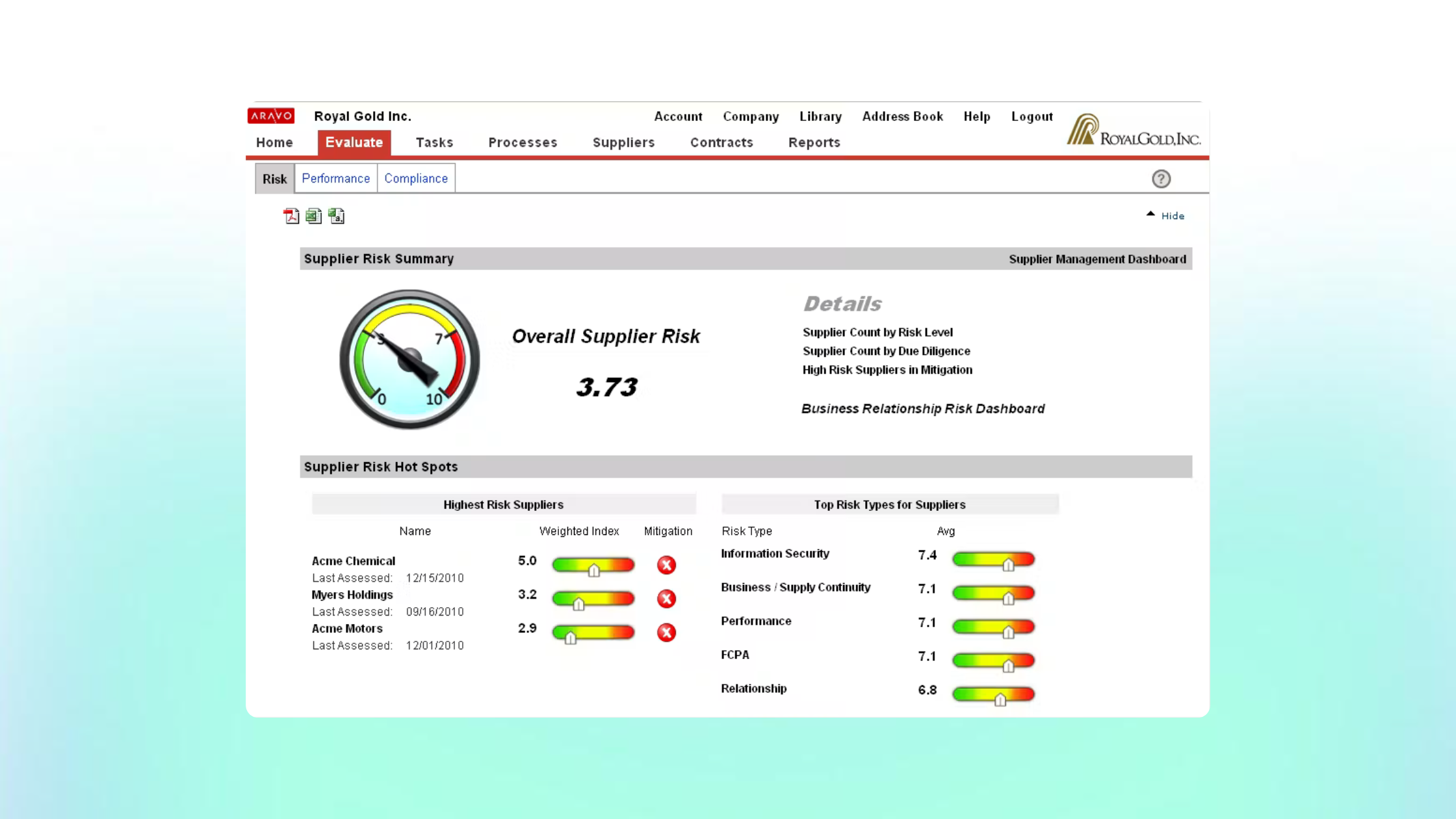
An enterprise platform covering the full third-party lifecycle, with configurable workflows and AI agents that automate routine review tasks.
Supplier evidence
Internal assessment data combined with external risk intelligence through more than 45 connectors, including BitSight and SecurityScorecard.
Beyond direct suppliers
Fourth-party and n-party relationships can be mapped and managed in the platform, including concentration exposure, with relationships recorded by the client rather than declared by suppliers on a shared network.
Supplier participation
Suppliers respond through Aravo's supplier-facing workflows; Aravo reports more than 5 million third-party users.
Ongoing assurance
Ongoing monitoring draws on the external intelligence providers a firm chooses to connect.
Operating effort
Gartner Peer Insights reviewers highlight the depth of Aravo's service and implementation support.
Key consideration
Subscriptions are priced by risk modules and number of users, so cost grows with scope. Best matched to large programmes covering several risk domains.
Mitratech Prevalent
Platform plus managed services
Mitratech Prevalent comparison
Best for
Teams that want a TPRM platform and a managed service to run assessments
Primary approach
A TPRM platform, now part of Mitratech's risk and compliance suite, offered alongside vendor intelligence and managed assessment services.
Supplier evidence
Client-issued questionnaires plus a library of pre-submitted standard assessments that suppliers can complete once and share with their customers.
Beyond direct suppliers
Reviewers value being able to map their supply chain in one place, particularly for procurement teams.
Supplier participation
G2 reviewers praise support responsiveness and a consistent interface across third parties.
Ongoing assurance
Automated monitoring tracks third-party risk between formal reassessment cycles.
Operating effort
One G2 reviewer described the platform as very complex with an overwhelming onboarding process; others want dashboards they can customise.
Key consideration
The managed service is a genuine advantage for teams without review capacity. Outsourcing assessments doesn't by itself add dependency or concentration visibility.
BitSight
Security ratings
BitSight comparison
Best for
Outside-in ratings across a large supplier portfolio
Primary approach
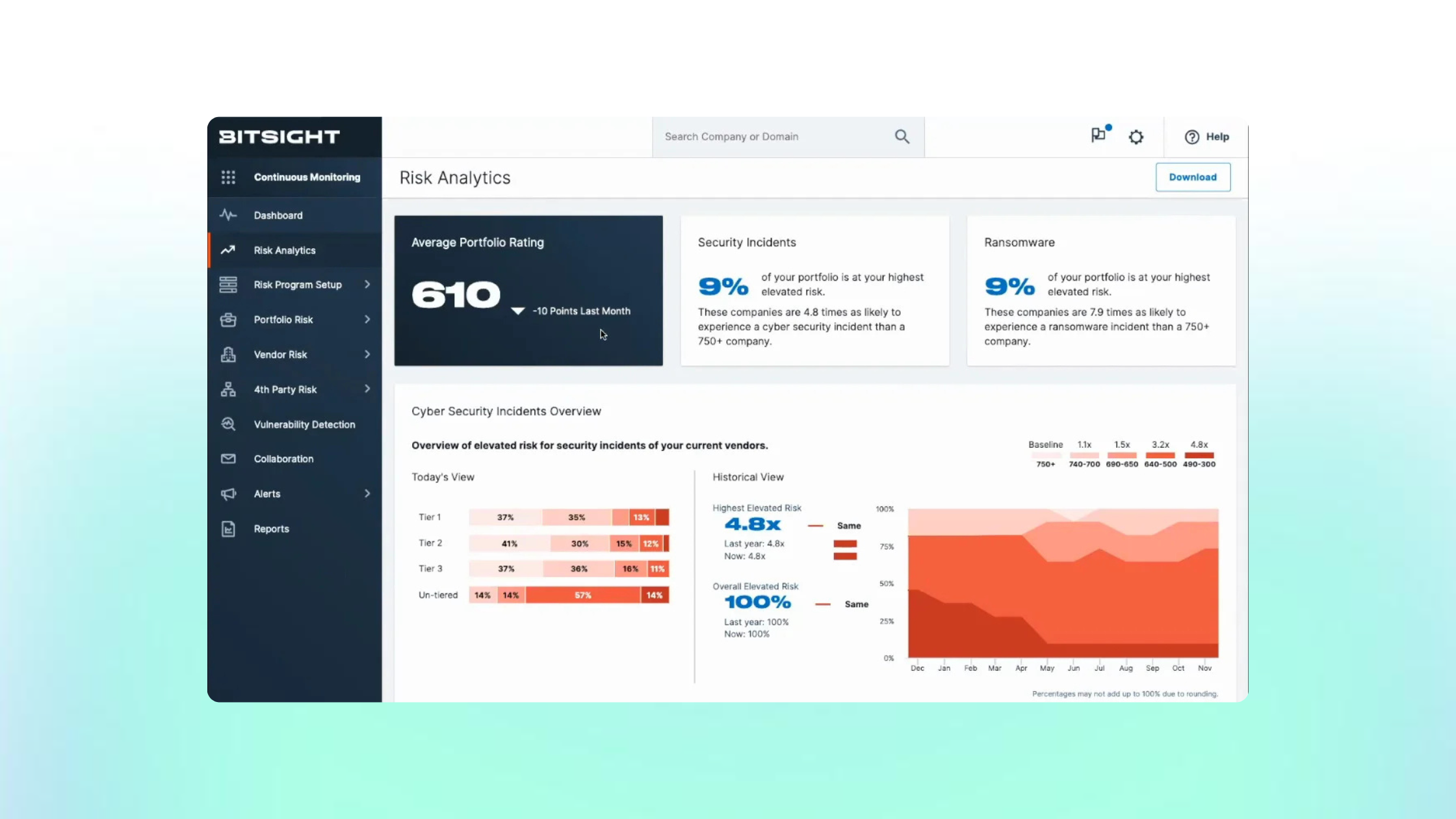
Scores organisations on a 250 to 900 scale from externally observable data, with a vendor profile layer added through its ThirdPartyTrust acquisition.
Supplier evidence
Vendors can share one set of questionnaires, certifications and attestations, which each client then reviews against its own criteria.
Beyond direct suppliers
Fourth-party mapping is built from external, observable internet data rather than dependencies suppliers declare themselves.
Supplier participation
No participation needed for a rating to exist, which is the point when broad coverage is the priority.
Ongoing assurance
Continuous external monitoring. Reviewers describe scores staying flat for a period after an issue has been fixed.
Operating effort
Reviewers praise the depth of findings on SSL, DMARC and DKIM, but note limited transparency in how scores are calculated.
Key consideration
Named a Leader in The Forrester Wave for Cybersecurity Risk Ratings Platforms, Q2 2026. Strong for portfolio-wide coverage, less suited to understanding a supplier's internal controls.
SecurityScorecard
Security ratings
SecurityScorecard comparison
Best for
Board-level ratings with sector peer benchmarking
Primary approach
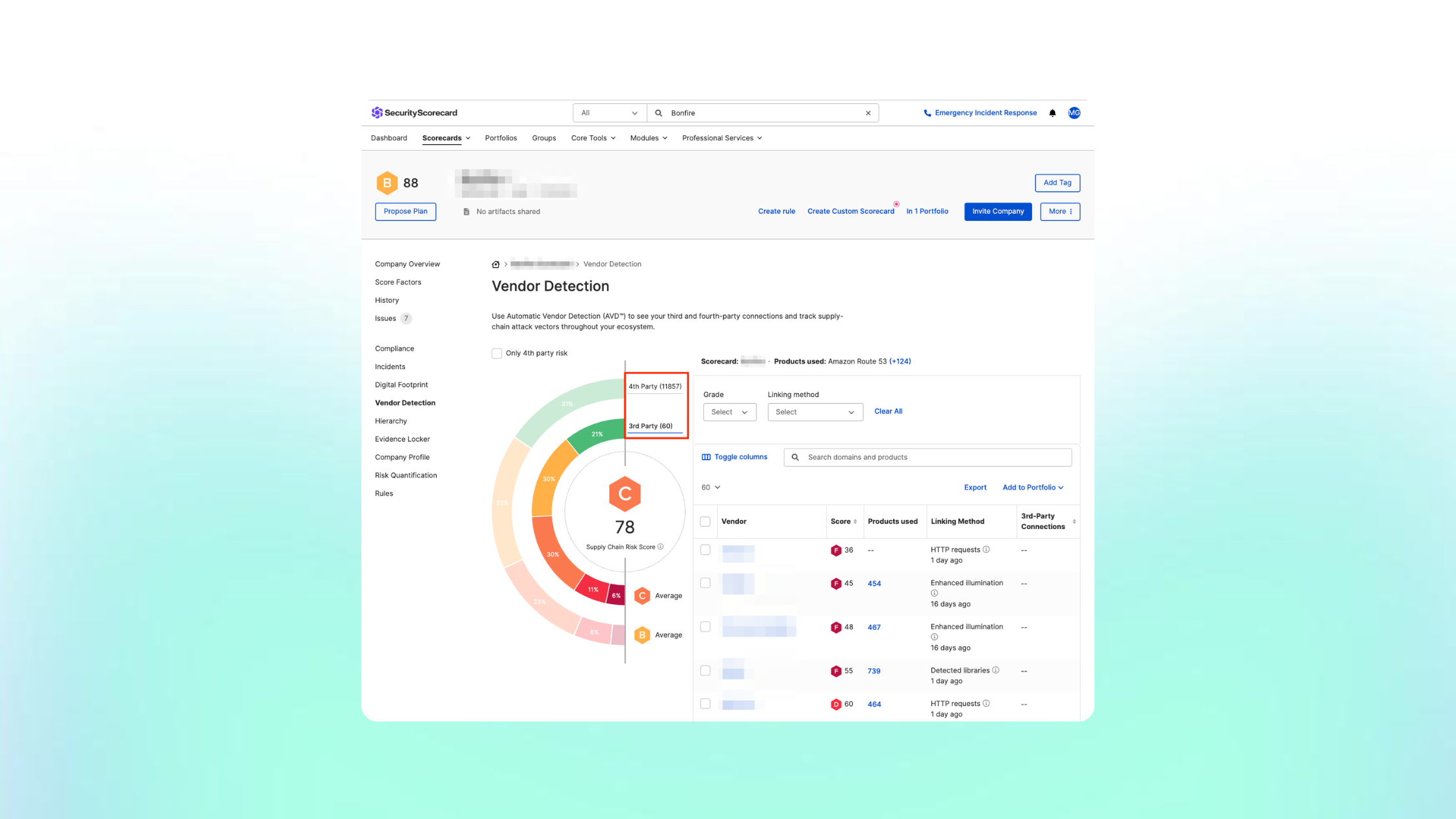
An A to F grade from outside-in data, paired with peer benchmarking and threat intelligence.
Supplier evidence
Suppliers can respond to findings and add context to their rating.
Beyond direct suppliers
Relationship data comes from external discovery rather than suppliers declaring it directly.
Supplier participation
Not required for a score; suppliers typically engage to dispute or explain findings.
Ongoing assurance
Continuous external scanning, with setup often taking a few days and no installation required.
Operating effort
Reviewers flag false positives and limited context behind rating changes, which need validating before action.
Key consideration
A fast, externally verifiable read for board or insurance reporting. Test attribution accuracy against your own domains before relying on it.
UpGuard
Ratings plus questionnaires
UpGuard comparison
Best for
One product for external monitoring and supplier questionnaires
Primary approach
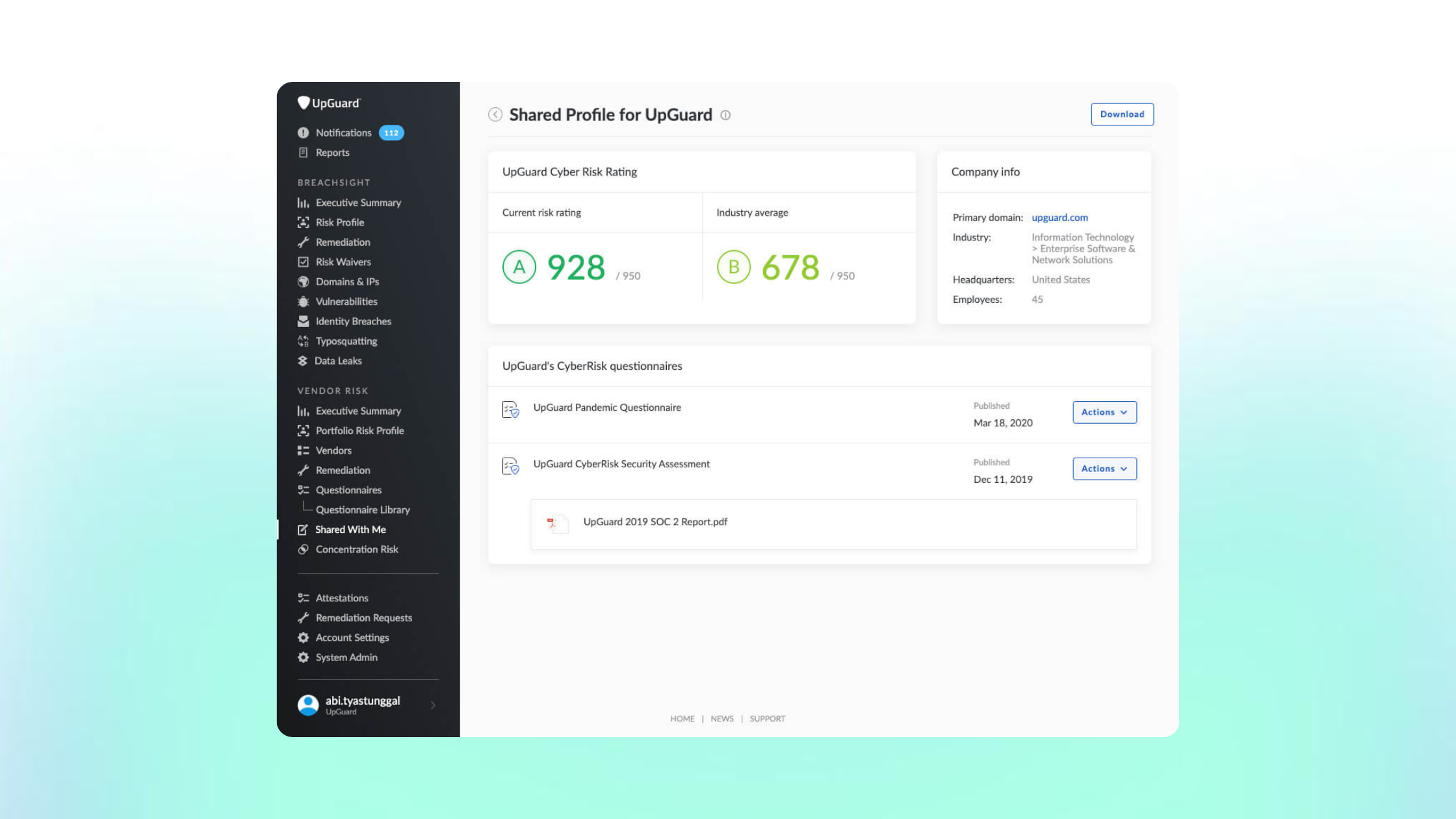
Outside-in security ratings combined with a questionnaire library covering NIST, ISO, SIG and regional regulations.
Supplier evidence
Client-issued questionnaires, with AI-assisted document review to speed up assessment.
Beyond direct suppliers
Automatic fourth-party detection from external data, available in higher pricing tiers.
Supplier participation
Suppliers complete questionnaires as each client requests them.
Ongoing assurance
Ratings update several times a day across attack surface, breach and data leak signals.
Operating effort
Reporting customisation is the most consistent reviewer complaint. G2 lists entry pricing from $1,750 per month.
Key consideration
Rated 4.5/5 from more than 650 reviews on G2, one of the highest-volume listings in the category. Weigh that against an inferred approach to dependencies.
Panorays
Assessments plus monitoring
Panorays comparison
Best for
Mid-sized teams that want assessments and attack-surface scanning side by side
Primary approach
Automated vendor questionnaires plus continuous external scanning in a single dashboard.
Supplier evidence
Automated questionnaires and evidence collection; reviewers consistently praise ease of use.
Beyond direct suppliers
Fourth-party discovery is built in, surfaced through scanning rather than declared by the supplier.
Supplier participation
Vendors respond through structured workflows; role granularity for larger teams is a noted limitation.
Ongoing assurance
Posture scanning runs alongside assessment data, producing a blended risk score from 0 to 100.
Operating effort
Reviewers raise onboarding effort and cost, along with occasional false positives.
Key consideration
Suits cyber-led programmes more than those run from procurement or compliance.
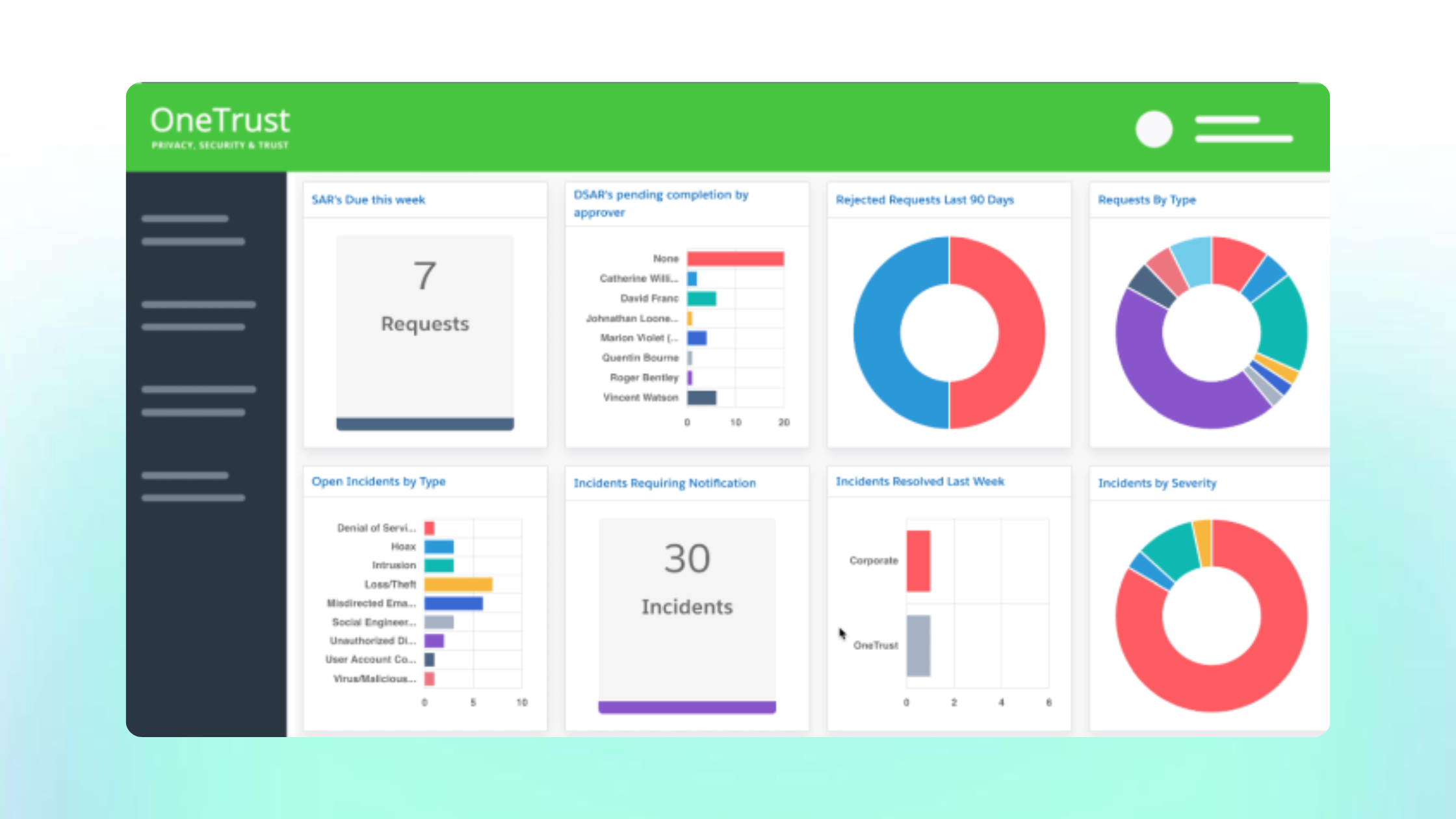
OneTrust
Broad GRC suite
OneTrust comparison
Best for
Third-party risk inside a wider privacy and compliance programme
Primary approach
Third-party risk sits as one module in a platform spanning privacy, ethics, AI governance and enterprise compliance.
Supplier evidence
A shared risk exchange lets vendors share assessments once, supplemented by configurable questionnaires mapped to more than 50 compliance frameworks.
Beyond direct suppliers
Governance breadth is the strength; nth-party mapping isn't the product's focus.
Supplier participation
Vendors respond through configurable assessment workflows rather than a reusable profile they maintain.
Ongoing assurance
Integrates external cyber risk feeds to trigger event workflows and reassessment.
Operating effort
Reviewers describe a steep learning curve, and pricing rises as more modules are added.
Key consideration
Strong where TPRM is part of a wider governance consolidation. Less efficient where third-party security is the only job.
Network-led TPRM: Risk Ledger
Risk Ledger is a network-first TPRM platform. Suppliers maintain one security profile against a standardised framework, reuse it across every client they connect to, and dependencies are mapped from real connections on the network.
Strengths
Answer once, reuse across clients: One standardised assessment is shared with every connected client, which cuts duplicated collection and keeps evidence comparable.
Free for suppliers: Joining and maintaining a profile costs the supplier nothing, which removes a common reason for non-response.
Dependency and concentration visibility: Shared providers behind several direct suppliers surface from network connections and supplier-named critical third parties.
Drawbacks
Less question-level flexibility: The standardised framework limits bespoke questions, a point one Gartner reviewer raised.
Narrower external scanning than a ratings platform: Outside-in coverage across thousands of suppliers is broader with BitSight or SecurityScorecard.
Not a GRC suite or managed service: Most firms keep a GRC platform as the system of record, and their own team still owns risk decisions.
Best use case
UK financial services teams with limited headcount that need reusable supplier evidence and a view of the shared dependencies behind their critical suppliers.
Enterprise TPRM platforms: ProcessUnity, Aravo and Mitratech Prevalent
Enterprise TPRM suites are configurable platforms built to run large, multi-stakeholder third-party programmes end to end.
ProcessUnity, Aravo and Prevalent all sit in this category. They differ mainly in how deeply they can be configured, how many risk domains they cover, and whether they'll run assessments for you.
ProcessUnity
ProcessUnity is a configurable TPRM platform built around lifecycle workflows, with a shared risk data exchange that gives early visibility of a vendor before a full assessment.
Strengths
Deep configurability: One G2 reviewer describes a tool a capable business user can administer without IT, with a test environment for changes before they reach production.
Integration options: Reviewers note native import and export plus an open API for connecting other systems.
Reliability: One reviewer reports two service interruptions in seven years, both under four hours.
Drawbacks
Configuration overhead: Reviewers note that changes need careful planning, and advanced reporting can depend on specialist administrators.
Performance: G2's review summary puts slow loading and timeouts at the top of user complaints.
Contract and contact gaps: One reviewer found managing multiple contacts per vendor awkward, and noted that contract management is basic.
Best use case
Mature programmes with dedicated admin capacity that want workflows shaped closely around their own policies.
Aravo
Aravo is an enterprise TPRM platform covering several risk domains, combining internal assessment data with external risk intelligence.
Strengths
Multi-domain coverage: Cyber, privacy, anti-bribery and ESG risk can run in one programme.
External data connectors: It links to more than 45 risk intelligence providers, including Dun & Bradstreet, LexisNexis, BitSight and SecurityScorecard.
Fourth-party mapping: Fourth-party and n-party relationships can be mapped in the platform, with concentration exposure taken into account.
Drawbacks
Cost grows with scope: Subscriptions are priced by risk modules and number of users.
Coverage depends on licensed feeds: Much of the external view comes through third-party data providers, so depth depends on which ones a firm connects.
Client-recorded dependencies: Relationships are mapped by the client rather than declared by suppliers on a shared network.
Best use case
Global enterprises running several risk domains in one programme. One Gartner reviewer singled out the depth of Aravo's service during implementation.
Prevalent
Prevalent, now part of Mitratech, combines a TPRM platform with a vendor intelligence network and managed assessment services.
Strengths
Managed assessments: Vendor risk assessment services can take review work off an internal team.
Pre-submitted assessments: A library of standard assessments lets teams check a vendor's status quickly or supplement their own reviews.
Responsive vendor: One G2 reviewer describes a team that takes criticism well and feeds suggestions back into the product.
Drawbacks
Complex onboarding: One G2 reviewer called the platform very complex and said onboarding felt overwhelming.
Rigid dashboards: Another reviewer wanted to customise the dashboard to see the data they need on login.
Questionnaire-centred: Outsourcing assessments reduces workload but doesn't by itself add dependency or concentration visibility.
Best use case
Teams without internal review capacity that want someone else to run supplier assessments.
Common misconception
"A shared assessment gives me shared visibility"
Feels like
An exchange or marketplace where suppliers share one completed assessment removes duplication, so it should deliver the same view as a supplier network.
Actually misses
A shared assessment answers the same questions once. It doesn't necessarily show who that supplier depends on, or which of your other suppliers share the same provider. Ask whether the platform records relationships between suppliers, not just reuses their answers.
Security ratings platforms: BitSight and SecurityScorecard
Security ratings platforms score suppliers from externally observable data, such as exposed services, patching signals and email security configuration, without needing the supplier to take part. BitSight and SecurityScorecard both work this way. That makes them fast to deploy across a large portfolio, but limited to what can be seen from outside.
BitSight
BitSight is a security ratings platform that scores organisations from external data, with vendor discovery that maps third-, fourth- and nth-party relationships using AI and scanning techniques.
Strengths
Coverage without participation: One G2 reviewer values a daily score that monitors their own systems and their vendors from outside, without needing anything from those vendors.
Actionable findings: Reviewers describe findings on public-facing weaknesses that come with detail on how to fix them.
Drawbacks
Scoring transparency: Reviewers ask for more visibility of the formulas behind grades.
Score lag: Improvements can take time to show up in a score.
Support response times: One reviewer reports first responses slipping from hours to several days.
Best use case
Firms that need an outside-in view across a large supplier portfolio, including suppliers who won't complete an assessment.
SecurityScorecard
SecurityScorecard grades organisations A to F from outside-in signals such as DNS health and patching cadence, and monitors those signals continuously across a vendor ecosystem.
Strengths
Readable at a glance: One G2 reviewer valued seeing a vendor's posture without getting lost in technical detail.
Clear risk categories: Breaking findings into categories such as DNS health and patching cadence helps teams prioritise remediation.
Reporting integrations: Another reviewer feeds the data into Power BI dashboards through the API.
Drawbacks
False positives: Reviewers note that external-only assessments can produce false positives and give limited context behind rating changes.
Reporting flexibility: One reviewer wants reporting that fits more closely with how their team segments work.
No view of internal controls: Findings still need supplier context before they support a risk decision.
Best use case
Board or insurance reporting that needs a quick, externally verifiable grade across many suppliers.
Common misconception
"A ratings platform that maps fourth parties shows my supply chain"
Feels like
If a platform can discover a supplier's fourth and nth parties from external data, it gives you the dependency map the 2027 register asks for.
Actually misses
External discovery shows where a relationship probably exists. It doesn't confirm whether the supplier relies on that provider for the service you actually consume. Ask whether suppliers can confirm or correct the relationships the platform has mapped.
Scanning plus questionnaires: UpGuard and Panorays
Combined scanning and questionnaire platforms put outside-in security ratings and supplier questionnaires in one product. Teams can prioritise suppliers by external signals, then ask for detail where it matters. UpGuard and Panorays both take this approach, and both are well reviewed. They differ mainly on customisation, pricing structure and how much setup they need.
UpGuard
UpGuard Vendor Risk combines continuous monitoring, AI-powered document analysis and security questionnaire automation in a single platform.
Strengths
Centralised assessments: One G2 reviewer moved questionnaires, evidence requests and follow-ups out of email and spreadsheets into one place, which cut admin and sped up reviews.
One balanced workflow: Another reviewer values having onboarding, assessment workflows, risk visibility and continuous monitoring together.
Drawbacks
Limited customisation: One reviewer found scoring and workflow hard to fine-tune to their internal risk methodology, and wanted more configurable reporting and approvals.
Tier-gated capability: Fourth-party risk monitoring and unlimited vendors sit in higher tiers, and reviewers say vendor caps are a common reason to upgrade.
Questionnaire navigation: One reviewer found section dependencies within questionnaires confusing.
Best use case
Security teams that want a fast-to-deploy product with transparent pricing for a defined number of vendors.
Panorays
Panorays combines automated security ratings, tailored questionnaires and continuous monitoring.
Strengths
One structured view: One G2 reviewer values having ratings, questionnaires and monitoring together, with a consistent way to track remediation and report to stakeholders.
Shadow IT discovery: A Gartner reviewer credits it with finding shadow IT assets and misconfigurations such as missing security headers.
Customer feedback: Forrester notes that reference customers praised the platform's flexibility and ease of use.
Drawbacks
Setup and cost: Reviewers raise initial onboarding effort and cost. One notes per-API-call charges, and another says pricing needs planning as usage grows.
Role granularity: Controlling what different user groups can see or change is limited for larger organisations.
Finding transparency: One Gartner reviewer couldn't see the source or reasoning behind a finding when trying to verify it before asking a supplier to remediate.
Best use case
Security-led teams that want ratings, questionnaires and attack-surface discovery in one workflow.
Enterprise GRC: OneTrust
GRC suites treat third-party risk as one module inside a wider governance, risk and compliance platform. OneTrust is the example covered here, and ServiceNow is the other common incumbent. The case for either is consolidation: one system of record for policies, audits, privacy and suppliers, rather than depth in supplier security.
OneTrust
OneTrust Third-Party Management is one module in a platform that also spans privacy, consent, AI governance and tech risk and compliance.
Strengths
Configurable templates and workflows: One G2 reviewer values being able to build templates with logic, create alternative workflows and connect other tools through APIs.
Reporting: The same reviewer highlights the built-in Power BI environment for extending reporting.
One platform for adjacent risk: Firms already running privacy or compliance programmes on OneTrust can manage suppliers in the same place.
Drawbacks
Learning curve: A reviewer describes the tool as vast, with a daunting learning curve for administrators.
Cost that grows with scope: Reviewers of OneTrust's wider platform describe pricing as opaque, with costs adding up as more modules are added.
Best use case
Firms consolidating third-party risk into an existing OneTrust privacy or compliance estate, where one system of record matters more than supplier-security depth.
Where FSQS, managed services and DIY fit
Industry schemes such as Hellios FSQS, managed assessment services and spreadsheet-based programmes each solve a narrower problem well.
However, these aren’t a direct substitute for a TPRM platform. The useful question is which part of the work you're trying to remove: data collection, review judgement or tracking.
Hellios FSQS
FSQS is a supplier qualification scheme built for financial services. The standard was created by banks, building societies, insurers and investment firms agreeing on a single way to collect third-party information. It covers information and cyber security, data privacy, business continuity, financial crime, conduct risk and financial standing. Suppliers complete it once instead of answering each member firm separately, and supplier managers also use it to find pre-qualified suppliers for new business.
Two features matter when comparing it with a TPRM platform:
First, Hellios collects and checks the data but doesn't assess a supplier's suitability, so that decision stays with each member firm.
Second, suppliers that need the more detailed Stage 2 qualification pay an annual fee, while small and micro businesses are fully subsidised.
FSQS is a strong fit for consistent procurement pre-qualification across many risk domains. Firms that need deeper cyber assurance or dependency mapping should check how far the scheme covers those before relying on it alone.
Managed assessment services
Managed services, such as those offered by Mitratech Prevalent, take review work off an internal team. They fit where the constraint is analyst capacity. The firm still owns the risk decision and its regulatory obligations. Outsourcing collection and review doesn't change where the evidence comes from, and it doesn't add a view of shared dependencies. Before buying, work out whether you need to outsource judgement or mainly the collection and chasing that comes before it.
Spreadsheets and internal builds
Spreadsheets, shared questionnaires and internal trackers are cheap to start and fully flexible. For a small supplier population with a handful of critical relationships, they can be enough. They strain as the programme grows. Nothing prompts suppliers to keep answers current, formats differ from one supplier to the next, and there's no practical way to see whether several suppliers depend on the same provider. The 2027 register adds to that strain, because the supply chain view it asks for has to be rebuilt by hand each year.
Which TPRM solution fits which financial services team?
The right TPRM solution depends less on feature lists and more on the specific problem slowing your programme down.
Most programmes recognise themselves in more than one statement, and that's normal. Mature teams often run two tools side by side. A common pairing is a GRC platform as the system of record, with a specialist tool supplying the supplier evidence and dependency data it can't generate on its own. The mapping points to where to start a shortlist, not where it has to end.
Decision helper
Statements are paraphrased from recurring themes in conversations with UK financial services security and risk teams.
"Two of us cover hundreds of suppliers, and most of the week goes on chasing."
Start withNetwork-led TPRM: Risk Ledger
Suppliers maintain one reusable profile for free, so evidence that already exists is connected rather than collected again.
"We need someone else to run the assessments."
Start withPlatform plus managed services: Mitratech Prevalent
Managed assessment services take review work off the internal team, while the firm keeps ownership of the risk decision.
"We need to know which critical suppliers rely on the same cloud or software provider."
Start withNetwork-led TPRM: Risk Ledger
Shared providers surface from real connections on the network and supplier-named critical third parties. Where you compare tools that infer dependencies, ask whether suppliers can confirm them.
Start withSecurity ratings: BitSight or SecurityScorecard
A rating needs no supplier participation, so it gives an outside-in view of suppliers who won't engage directly.
"Our questionnaire answers are out of date by the time we review them."
Start withNetwork-led TPRM, or scanning plus questionnaires: UpGuard or Panorays
Supplier-maintained profiles reduce staleness at source. Combined tools add external signals between formal reviews.
"The board wants one score for every supplier."
Start withSecurity ratings: SecurityScorecard or BitSight
Letter grades and numeric scores are built for executive reporting, as long as the team validates findings before acting on them.
"Our programme spans cyber, ESG, anti-bribery and financial risk, with several teams involved."
Start withEnterprise TPRM suites: Aravo or ProcessUnity
Multi-domain coverage and deep configuration suit large programmes with dedicated administrators.
"We already run privacy and compliance on one platform and want suppliers in the same place."
Start withGRC modules: OneTrust or ServiceNow
Consolidation into an existing system of record is the main benefit. Check how much supplier-security depth the module adds on its own.
How we approach financial services TPRM at Risk Ledger
We built Risk Ledger as a network rather than a questionnaire tool. The hardest questions in financial services TPRM sit between suppliers, not inside any one of them.
Suppliers maintain one profile for free, you connect to it, and the connections across 19,000+ organisations show you what your suppliers depend on.
Start from your real supplier list
We start with the suppliers you actually have. A coverage check shows which are already on the network and can be connected straight away, and which need an invitation. Your tiering, policies and risk appetite then sit on top of each supplier's profile, so a critical payments processor and a low-risk facilities supplier aren't held to the same bar.
One profile, reused, with your policies on top
Each supplier completes one assessment against our standardised framework and shares it with every client it works with. That's where the reduction in chasing comes from. It also comes with a trade-off we're open about in every evaluation.
“
You're taking a five or 10% hit on the granularity of questions you can
ask because you're adopting our common framework, but in return you're
getting a much broader data set against a much broader number of
suppliers.
Haydn BrooksCEO, Risk Ledger
Seeing what your suppliers depend on
Many suppliers on our network are also clients assessing their own suppliers, so chains of connection form from the network itself. Suppliers also name their own critical third parties within the assessment. Put together, you can see where a single provider sits behind several of your suppliers that look independent on paper. A cloud platform supporting your payments processor, your CRM supplier and your outsourced contact centre would be one example. If that provider has an outage, all three are affected at once.
For UK firms, this gives you a working starting point for the supply chain view the 2027 register asks for, built from connections that already exist rather than rebuilt in a spreadsheet each year. How much of the picture appears on day one depends on how many of your suppliers are already connected, which is exactly what the coverage check tells you.
When an incident hits
In one case we've seen directly, a supplier holding data for a financial services customer suffered a breach. The supplier notified the customer, but it didn't know the customer's incident response plan, who to escalate to, or what response times were expected. The supplier had no regulatory reporting duty of its own. The customer did, with a regulator in Singapore that sets one of the tightest reporting timelines in the sector. The two teams had to work out how to respond together in the middle of the incident.
When a new threat is published, our Emerging Threats workflow sends a standard question to relevant suppliers. Each answer reaches every connected client, so you aren't writing the question and chasing replies from scratch. Agreeing escalation contacts and notification timelines in your contracts is still your job, and that work is worth doing before an incident, not during one.
What this looks like in practice
Schroders Personal Wealth, a joint venture between Lloyds Banking Group and Schroders, reports that third-party risk work which used to need several full-time staff now needs one. Non-compliance with its priority criteria is flagged to procurement straight away, instead of surfacing after months of spreadsheet review.
What security teams in financial services ask next
What should UK financial services firms look for in a TPRM solution?
Start with where supplier evidence comes from and how current it stays, then check whether the platform can show the shared dependencies behind your critical suppliers. UK firms should also test how it supports the material third-party reporting rules that apply from 18 March 2027, what suppliers pay to take part, and how much internal effort the platform needs once it's running.
Does the critical third parties regime change a firm's own third-party obligations?
No. The critical third parties regime brings designated providers, currently Amazon Web Services, Google Cloud, Microsoft and Oracle, under direct regulatory oversight for the systemic services they supply to the sector. It places obligations on those providers, not on the firms that use them. Firms still manage and report their own material third-party arrangements under separate FCA and PRA rules.
Can a TPRM platform help with the FCA and PRA material third-party register?
A platform can supply much of the underlying data, such as which suppliers support which services, their current control evidence and, in some cases, who those suppliers depend on. It won't complete the register for you. The FCA has kept the requirement to look down the supply chain, so check whether a platform's dependency data comes from real connections or is inferred from external signals.
What is the difference between a security rating and a TPRM platform?
A security rating scores a supplier from externally observable data without the supplier taking part. A TPRM platform manages the wider process of assessing, monitoring and remediating supplier risk, usually with evidence from the supplier itself. Some platforms combine both, and many teams use a rating to decide which suppliers need a deeper assessment.
Can a TPRM platform show fourth-party and concentration risk?
Several can, but the source of the data differs. Ratings and scanning platforms infer fourth-party relationships from external signals, and enterprise suites let you record them yourself. Network-led platforms such as Risk Ledger surface them from real connections between organisations and from suppliers naming their critical third parties. For concentration risk, ask whether suppliers can confirm the relationships a platform shows.
Is Hellios FSQS a TPRM platform?
No. Hellios FSQS is a supplier qualification scheme for financial services. Suppliers complete one standard questionnaire covering areas such as cyber security, data privacy and business continuity, which member firms then draw on. Hellios collects and checks the data, but each member firm makes its own decision about a supplier's suitability.
Is Risk Ledger free for suppliers?
Yes. Suppliers join Risk Ledger and maintain their security profile at no cost, then share it with every client they connect to. Clients pay for the platform. Removing the supplier fee takes away one of the most common reasons suppliers don't respond to assessment requests.
.png)

 Haydn Brooks
CEO, Risk Ledger
Haydn Brooks
CEO, Risk Ledger



.svg)