By clicking “Accept”, you agree to the storing of cookies on your device to enhance site navigation, analyze site usage, and assist in our marketing efforts. View our Privacy Policy for more information.
Nth-Party Risk: How Hidden Supplier Dependencies Create Exposure
How nth-party risk develops through supplier dependencies, how it differs from fourth-party risk, and how to map, prioritise and monitor exposure.
Risk Ledger
|
Company
September 24, 2026
|
19
mins read
Share
Quick answer
Nth-party risk is exposure that comes from supply chain connections beyond your direct suppliers - the fourth, fifth and deeper-tier providers you never contracted with but still depend on.
Only 30% of organisations have visibility over their critical nth-party connections, against 50.2% for fourth parties.
A shared nth-party dependency can turn two suppliers you thought were redundant into a single point of failure.
Traditional TPRM assessments don't reveal shared connections between your third parties.
70% of organisations cannot identify concentration risks among their deeper-tier providers.
Managing it means mapping and monitoring the dependencies that matter, not assessing every supplier in the chain.
These unseen nth-party dependencies not only expose you to cascading supply chain failures, but mask critical concentration risks that can severely hamper your business operations and even derail your disaster recovery (DR) strategy.
For instance, one of the nth-party risks we frequently see is the ‘failover-that-isn't-a-failover’ situation where a company’s primary and back-up supplier for a critical service (e.g. identity access management) shares the same nth-party connection (e.g. cloud provider) without the company knowing. If the nth party fails, both the primary and back-up supplier go offline at the same time, rendering the company’s purpose-built ‘redundancy’ measure redundant.
As digital supply chains become increasingly interconnected, your exposure to nth-party risk grows. But most traditional Third-Party Risk Management (TPRM) approaches do not reveal shared connections between your third parties, let alone flag concentration risks emerging from deep nth-party relationships.
The only way to manage nth-party risk is by expanding your field of vision, mapping nth-party connections to your critical services and monitoring key changes to nth-party dependencies. This guide will show you how.
In this guide, you will learn:
Where nth-party risk sits in your supplier ecosystem
The difference between third-party, fourth-party, nth-party and concentration risk
How hidden supplier dependencies create business exposure
How nth-party risk creates hidden concentration risk
Which nth-party dependencies actually matter?
How to map supplier dependencies without assessing everyone
How to assess and prioritise nth-party risk
How to monitor nth-party risk over time
How nth-party visibility improves incident response
What to look for in an nth-party risk management approach
How Risk Ledger supports nth-party visibility
Where nth-party risk sits in your supplier ecosystem
Unlike a direct third-party SaaS supplier or indirect fourth-party cloud provider, an nth-partysupplier does not refer to a specific tier. It refers to any relevant organisation in your supplier ecosystem beyond your direct suppliers.
Here’s a simple way to think about it.
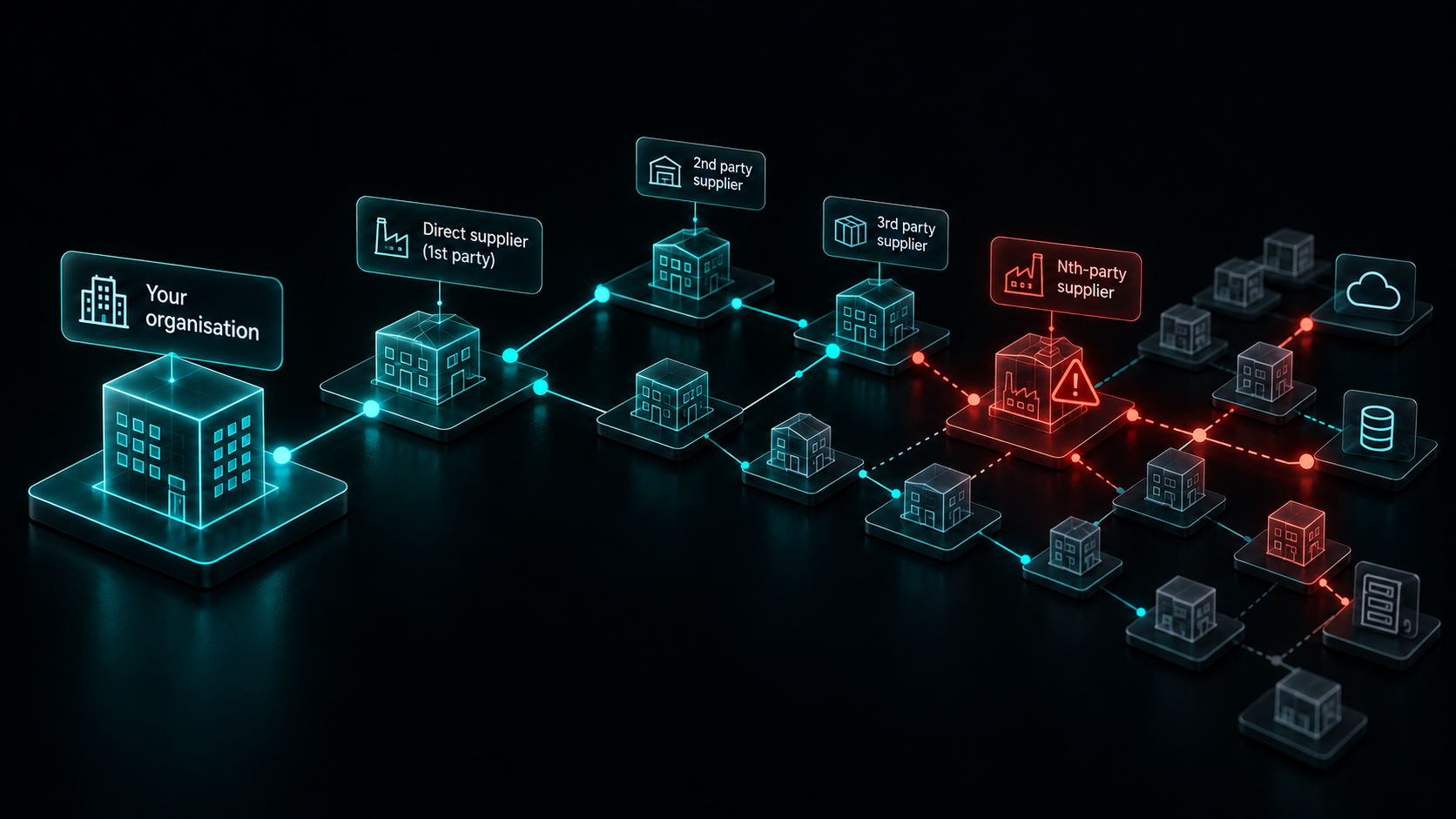
First party: Your organisation
Second party: Your customers
Third party: Your direct suppliers
Fourth party: A supplier used by your third-party supplier
Fifth party and beyond: Deeper dependencies
Nth party: Collective term for the extended chain beyond direct suppliers (third parties)
Although nth parties do not have a direct connection with you, your operations still depend on them. For example, if 10 of your third-party suppliers rely on AWS for their cloud infrastructure, an outage at AWS could bring down all 10 suppliers at the same time, severely restricting your business functions.
This is the essence of nth-party risk. It’s risk that sits beyond your direct connections and beyond where most organisations have visibility, but still has the potential to cause severe operational, financial and reputational impacts through system downtime, data breaches, regulatory penalties and loss of customer trust.
The difference between third-party, fourth-party, nth-party and concentration risk
A question we hear a lot is: is nth-party risk just another term for fourth-party risk? In short, no.
While different organisations use different terminology to describe supply chain connections and dependencies, these terms are not interchangeable as nth-party risk does not refer to a specific tier, type of supplier or threat.
Here’s the core differences between these core supply chain risks.
Third-party risk
Third-party risk focuses on how your directly contracted suppliers, such as your payroll software or PR agency, could harm your organisation. For instance, an outage at a third party could take the individual supplier’s services offline and disrupt a core business function.
As you have a direct contractual relationship with third parties, most organisations rely on traditional TPRM supplier assessments to identify, evaluate and monitor third-party risk. Security teams can also use procurement lists to build a database of third-party suppliers, highlight which services they support and assign risk ratings.
Fourth-party risk considers the impact your suppliers’ suppliers could have on your organisation.
Be it subprocessors or data storage platforms, a breach at a fourth party could affect many of your third-party suppliers simultaneously, potentially crippling your own business operations.
Although you have no direct connection with fourth parties, you inherit the operational and cyber exposure from your third-party supplier, but lack the contractual control to perform security due diligence or monitor their changing security posture.
Nth-party risk refers to exposure originating from supply chain connections beyond your third parties, such as fourth-party payment providers, fifth-party cloud infrastructure or sixth-party data centres.
Concentration risk does not refer to a specific tier or relationship, rather a situation where one supplier can become a single point of failure. A direct concentration risk occurs when you depend too heavily on a supplier to deliver multiple critical services. A hidden concentration risk occurs when multiple suppliers are resting on the same underlying connection. In both cases, one incident can affect many of your critical services simultaneously and significantly limit your ability to carry out key business functions. To effectively identify, monitor and mitigate concentration risks, you need live supply chain mapping, not static suppliers lists.
Typical visibilitySupplier register, contract and assessment
Main management questionIs this supplier secure and resilient enough for the service?
Fourth party
RelationshipSupplier's direct dependency
Contractual controlIndirect
Typical visibilitySubcontractor disclosure or dependency mapping
Main management questionWhich important providers does our supplier rely on?
Nth party
RelationshipAny deeper-tier dependency
Contractual controlLimited or none
Typical visibilityNetwork and dependency analysis
Main management questionWhich hidden dependencies could affect critical services?
Concentration risk
RelationshipShared dependency across relationships
Contractual controlVaries
Typical visibilityPortfolio or network-level analysis
Main management questionWhere could one failure affect several suppliers or services?
How hidden supplier dependencies create business exposure
Loss of service availability. Compromised data. Regulatory exposure.
In today’s interlinked digital supply chains, you don’t need a direct contractual relationship to suffer significant disruption. Whether it’s several suppliers failing at the same time or failing to meet critical-service tolerances, hidden supplier dependencies can expose you to severe operational business impacts.
Here are some of the most common.
Shared technology providers
Think about the interconnected stack of APIs, cloud providers and managed service providers your business relies on to fulfil business functions. Now think about the technology partners these third-party tech suppliers depend on for their business functions.
The likes of cloud hosting platforms and data processors are some of the most common shared tech providers. If one of them fails, all connected third parties could go offline simultaneously, potentially impacting your service delivery and leaving your customers in the lurch (which is exactly what happened in 2025 when a Cloudflare outage caused multiple financial apps to go offline).
Subcontracted critical services
Unless explicitly stated in the service agreement, a tech supplier may outsource an important part of the service they provide while remaining the contractual owner. Cloud hosting is a classic example with third-party SaaS tools often storing all their data on AWS or Microsoft Azure.
But it’s not just the hyperscalers. For instance, you might contract with a cybersecurity platform that outsources its threat monitoring feature to a smaller SaaS tool. If the smaller SaaS tool suffers a data breach, the disruption can quickly end up at your door.
Software dependencies
How is the software you depend on built? Many third-party products may ultimately rely on open-source packages, libraries and repositories to function, leading to an nth-party dependency you have no idea about.
For example, the DevOps community was rocked in 2023 when one of the most popular Infrastructure as Code (IaC) tools, Terraform, was transferred from open source to a Business Source License, preventing third-parties from using it and forcing them to look for alternatives.
Privileged access inherited through a supplier
Although they operate externally, third parties often interact with your systems, processes or customer data. In turn, their subcontractor may end up holding administrative or support access to systems used to deliver the contracted service.
As you go down the supply chain, unknown nth parties can get highly privileged access they haven’t been vetted for. If they suffer a breach, you’re the one liable. For example, in 2018, the exposure of Ticketmaster’s customers’ payments details through a fourth-party software breach resulted in a GDPR fine of £1.25 million.
Data passing into deeper tiers
This happens when a supplier sends data to processors or technology providers that were not visible during the original review. For instance, as companies rush to adopt new AI tooling, a supplier may introduce API connections to a fourth-party AI provider and create a new data flow that neither you or potentially the supplier’s security function knows about.
Even if suppliers are contractually obliged to update you before engaging a new subprocessor, the typical answer is a link to a public page and an invitation to object if worried.
How nth-party risk creates hidden concentration risk
The deeper you go in the supply chain, the more likely that concentration risks occur, but the less likely you can see them.
In our 2026 State of Supply Chain Security report, the lack of visibility into dependencies beyond direct third parties was the most commonly cited TPRM shortcoming by cybersecurity professionals (24.8% of respondents).
How much visibility organisations actually have
High visibility into direct subcontractors of critical third parties (fourth parties)50.2%
Full visibility into the entire chain of subcontractors (nth parties)30%
Only partial visibility into some fourth parties16%
No visibility beyond direct critical third parties3%
Source: Risk Ledger, State of Supply Chain Security 2026 - UK Edition
Technology concentration risk. When several suppliers depend on the same cloud platform, software provider or identity service, it only takes one incident to disrupt your standard business operations. For example, the 2024 Crowdstrike incident took 8.5 million Microsoft devices offline.
Service concentration risk. When several business services rely on the same managed providers to operate core parts of their operations, such as IT, infrastructure, security or support, an incident can quickly cascade through multiple systems. For instance, the 2021 Kaseya VSA ransomware attack affected 50+ MSPs and disabled the systems of 1500 downstream businesses.
Geographic concentration risk. It’s easy to forget that all digital supply chains rely on physical infrastructure - from data centres supporting cloud computing to deep sea internet cables. If your critical services are based in asingle country, city or region, then it’s prone to disruption from natural disasters, political unrest or energy grid failures, such as the power blackout in Spain and Portugal in 2025.
Operational concentration risk. When a specialist subcontractor supports several otherwise separate suppliers, an incident can cause all those tools to lose operational functionality. The emergence of Gen AI has made this even more likely with most SaaS businesses overlaying LLM models (from the likes of OpenAI and Anthropic) for their own tooling. If the LLM license changes or an outage occurs, all those operations go offline.
Data concentration risk. If several suppliers send data to the same processor or platform then a breach could not only disrupt your operations, but cause a data leak that has far-reaching reputational, financial and regulatory consequences. For instance, an issue at large CRMs, such as Salesforce and Hubspot, would disrupt marketing, sales and customer success functions, and put customer data at risk.
Just because 10 of your suppliers depend on Microsoft Azure doesn't necessarily mean you need to take mitigation action. In financial services, for example, the ‘big three’ cloud providers (AWS, Azure, GCP) serve more than 80% of the industry. The key is pinpointing the nth-party dependencies that could affect your critical business functions and taking action there.
So, when it comes to addressing nth-party risk, the first move isn't buying nth-party mapping software, it's working with procurement to figure out which of potentially thousands of suppliers are critical to your operations. For instance, if your Identity and Access Management (IAM) software goes down and prevents customers from logging into your app, it’s much more of an operational headache than your expense management platform suffering an outage.
Prioritise first, then map
Instead of prioritising an nth-party dependency simply because it sits deeper in the supply chain, prioritise it because of the access, dependency, concentration or business impact it creates.
We recommend prioritising dependencies when several of these conditions apply:
It supports a critical business service.
It stores or processes sensitive data.
It has privileged or production access.
Several important suppliers rely on it.
Failure would be difficult to work around.
Replacement would take longer than the permitted recovery window.
The direct supplier has limited control over it.
The dependency is difficult to identify or contact during an incident.
The existing evidence is incomplete or stale.
The provider is relevant to a current vulnerability or emerging threat.
DependencySupports critical service?Shared by several suppliers?Easy to replace?Sensitive access or data?Priority
Provider A
Supports critical service?Yes
Shared by several suppliers?Yes
Easy to replace?No
Sensitive access or data?Yes
PriorityImmediate
Provider B
Supports critical service?Yes
Shared by several suppliers?No
Easy to replace?Yes
Sensitive access or data?No
PriorityMonitor
Provider C
Supports critical service?No
Shared by several suppliers?Yes
Easy to replace?Yes
Sensitive access or data?No
PriorityLow
How to map supplier dependencies without assessing everyone
After establishing your critical suppliers, it’s time to map their connections.
Modern supply chains are endless with potential vulnerabilities at any point, but no organisation can - or should - map every potential connection. Instead, you should focus where there is most risk.
Start with critical services. Identify the services whose disruption would create the greatest operational, financial, regulatory or customer impact.
Link those services to direct suppliers. Note down which business supports each service, including the business owner, data handled, access provided, the recovery requirement and the current security contact.
Ask direct suppliers for their critical dependencies. Collect key dependency information about relevant fourth parties to help you connect each critical service with its nth-party dependencies. Ask your direct suppliers questions like:
Which providers are essential to delivering this service?
Which organisations host, process or back up our data?
Which providers have privileged access?
Which dependencies have no short-term alternative?
How would you notify us if one was disrupted?
Validate and structure the information. Ask for contracts, supplier evidence, technical architecture and software composition information to corroborate the vendor’s intel. You can also reach out to fourth parties for confirmation.
Identify shared dependencies. Look for providers used by several critical suppliers. This could be obscure, low-spend SaaS tools or giant hyperscalers (our own network data found that Google, AWS, Microsoft, Salesforce and HubSpot were the most common fourth parties).
Connect dependencies to response decisions. Use this dependency knowledge to inform your failover plans and DR strategy. For example, for each critical dependency, you should define:
The owner
Expected notification route
Required evidence
Alternative service or workaround
Escalation threshold
How to assess and prioritise nth-party risk
Even after mapping all the nth-party risks linked to critical services, you can't manage and solve each and everyone. To decide where to investigate further or intervene, you should assess and prioritise each of the risks according to these core criteria.
Business criticality. What service could be affected and what would be the operational impact?
Dependency strength. Is the provider essential or can the supplier switch to an alternative?
Access and data. Does the nth party handle sensitive data or hold privileged access?
Concentration. How many suppliers or services depend on the same provider?
Control and assurance. What evidence is available through the direct supplier and how current is it?
Incident readiness. Can the direct supplier identify exposure, contact the nth party and provide useful information quickly?
Threat relevance. Is the provider, software or service affected by a current vulnerability, outage or campaign?
Which of these criteria matter most to you will depend on your business’ goals and your own internal risk appetite. For instance, you may be more willing to tolerate an nth-party risk if the third party provides a specialist service or if the cost to mitigate the risk exceeds the potential impact of an incident.
So instead of using the criteria to create an arbitrary nth-party risk score, it’s better to classify them into priority categories with each classification triggering a different evidence requirement, review cadence and incident-response expectation.
For example:
Critical dependency. Nth-party risks with a potentially devastating business impact that require urgent action.
Material dependency. Nth-party risks with a disruptive impact that require mitigation action when possible.
Monitored dependency. Nth-party risks with a medium-level impact that require monitoring.
Recorded dependency. Nth-party risks with a minor impact that should be logged.
Real-life example: mitigating a critical nth-party dependency
In 2020, the NHS Test and Trace team purposefully chose two separate suppliers to provide a critical chemical reagent required for COVID testing, so that if one had an incident or went bust, they could default to the second.
However, using Risk Ledger’s mapping function, they discovered that both of those third-party suppliers actually relied on the exact same fourth-party supplier underneath them. All they had done was inadvertently push their bottleneck one layer further down the supply chain.
Given the critical and specialist service of the suppliers, NHS Test and Trace couldn’t afford for them to fail or easily find replacements, so they worked directly with the suppliers to find different fourth parties, helping decouple the supply chain and mitigate the nth-party risk.
Due to TPRM limitations, only 44.8% of organisations continuously monitor critical suppliers and 53.6% of firms are limited to quarterly or event-triggered updates. This continuous monitoring gap becomes even wider with nth-party risks where visibility is notoriously poor and you have no direct contractual control to demand security updates. So how do you know when a critical nth-party dependency has changed?
The key is to focus on what you can control and see. This includes monitoring for relevant changes, such as:
A supplier adds or replaces an important subcontractor.
A critical service moves to a new hosting provider.
A merger or acquisition changes the dependency structure.
A relevant certificate or security assurance expires.
A dependency becomes affected by a vulnerability or breach.
Several suppliers begin using the same provider.
A previously replaceable dependency becomes operationally critical.
Supplier contact or escalation information changes.
Remediation actions remain incomplete.
After noting a material change at a dependency, you should reach out to the supplier to confirm and determine how this affects your operational resilience before making a decision to act or not.
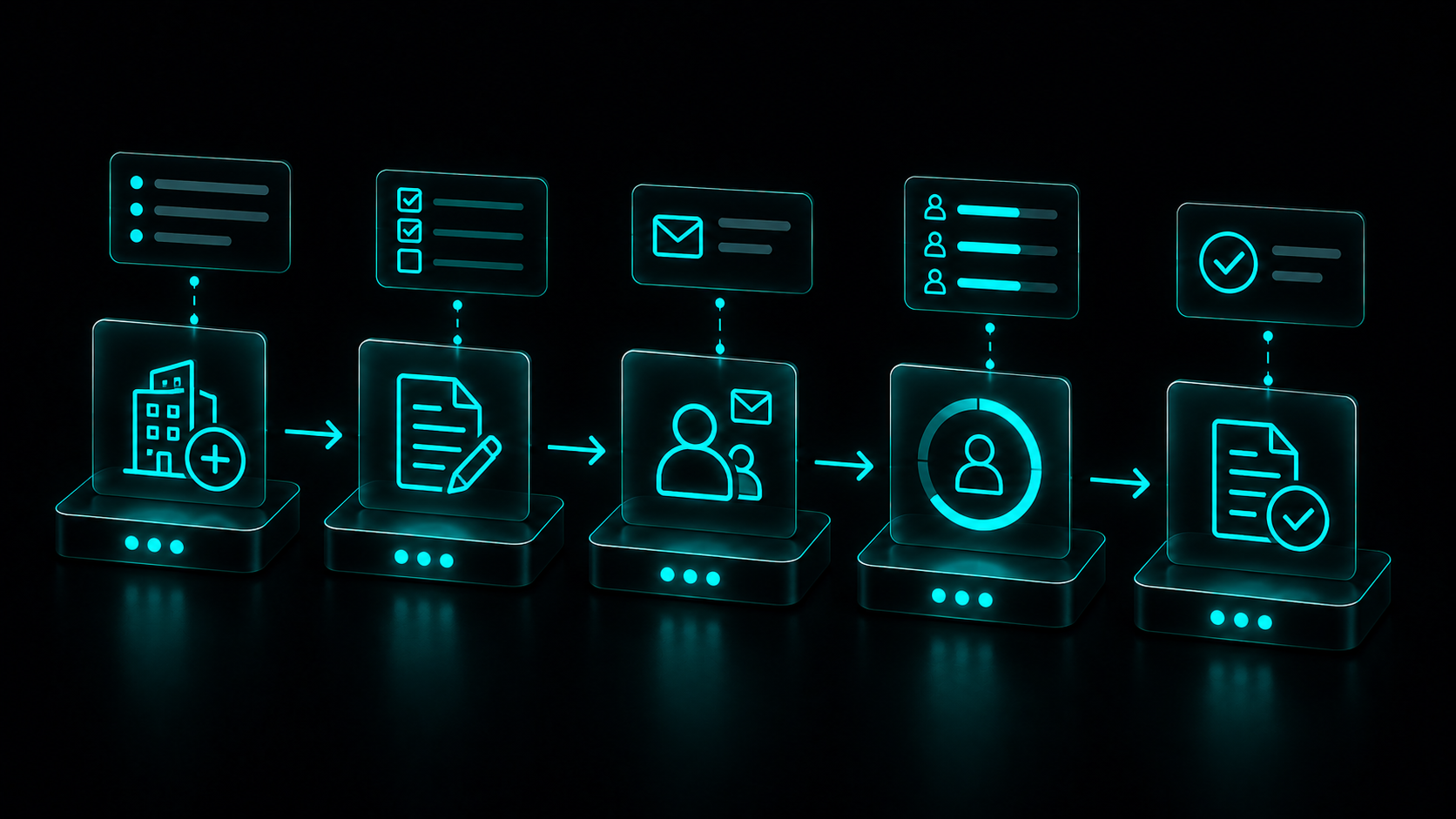
1
Record dependency.
2
Detect material change.
3
Confirm with supplier.
4
Apply business context.
5
Take action or record acceptance.
Remember: every time you track a relevant development at a nth-party dependency, this should lead to a tangible outcome - be it simply updating dependency information and documenting the decision or triggering a review and prioritising internal action.
How nth-party visibility improves incident response
Supply chain mapping and continuous monitoring are essential parts of nth-party risk management, revealing hidden and changing dependencies that could impact your business. But they’re also essential tools when incidents occur.
Whether you find out about a breach privately through an affected supplier or publicly via the news, security teams often struggle to understand the potential impact on their operations as they don’t know which of their suppliers - and therefore services - are going to be affected. In fact, 56% of enterprises admit they cannot map their extended supply chain’s exposure to an emerging threat within 24 hours of an incident.
However, with a bird’s eye view of the entire network, you can quickly establish which individual organisations are connected, which suppliers they rely on and where risk can spread. You can then reach out to contacts at these suppliers to confirm the breach and monitor how it cascades.
During supply chain incidents, we recommend following this workflow:
Validate the vulnerability, outage or breach.
Search for direct use of the affected organisation or technology.
Identify direct suppliers that depend on it.
Map those suppliers to critical services.
Prioritise by business impact and concentration.
Contact direct suppliers with targeted questions.
Confirm actual exposure and mitigation.
Brief internal stakeholders.
Track remediation and residual risk.
Update the dependency record.
Key questions for direct suppliers during incidents
Do you or your critical subcontractors use the affected service?
Which customer-facing services could be affected?
Is exploitation or disruption confirmed?
What containment or workaround is in place?
Is customer data involved?
Which deeper-tier provider owns remediation?
When will the next update be provided?
Regulatory control
Following this workflow also provides proof to your C-suite, investors, customers and regulators that you were in control of the situation.
While regulation has yet to include nth-party risk management mandatory, this appears to be the preferred direction of travel with recent regulatory updates making explicit reference to the risks posed by sub-contractors and fourth-party suppliers, such as the 2026 updates to PRA SS2/21.
When boiled down, the core ingredients of an nth-party risk management approach are not too dissimilar to the core criteria of a best-in-class TPRM approach. You need:
Network visibility to find shared dependencies. Static Excel-based lists of third-party suppliers no longer cut it. Today, you need live supply chain mapping to provide the required visibility of third-party and nth-party connections. This not only lets you see concentration risks and changing supplier relationships (i.e. every time a critical supplier makes a new connection), but helps you monitor and mitigate incidents in real-time.
Contextual data to support prioritisation. A map is pointless without reference points, so showing how each connection relates to your critical services is crucial. Adding contextual data helps you know which nth-party concentration risks are the most important and where to take action, such as mitigating critical nth-party risks in the next quarter and addressing material dependencies in the following quarter. What’s more, it helps CISOs prove to the board why additional investment is needed.
Continuous monitoring to pinpoint changing risks. Instead of asking third-party suppliers for updates on an annual basis, you need to monitor changes to nth-party risk continuously. That means setting up a monitoring workflow for critical dependencies (outlined earlier in the guide), ideally with alerts that inform your SOC of material changes and emerging threats.
Supplier collaboration to support proactive response. In an interconnected supply chain, the entire supplier community - from your organisations through to nth-party connections - need to work together to optimise operational resilience. You therefore need a means to communicate seamlessly with suppliers, including those you don’t share a contractual connection with, to confirm dependency changes and coordinate defence when incidents occur.
Nth-party risk management checklist
Is your nth-party risk management approach up to scratch? Ask yourself these questions:
Can it connect suppliers to business services?
Can suppliers identify and maintain important dependencies?
Can it distinguish critical dependencies from incidental ones?
Can it show shared providers across several suppliers?
Can analysts move from a concentration view to the affected relationships?
Can dependency changes trigger review?
Can it connect emerging threats to affected suppliers?
Can teams record evidence, decisions and remediation?
Can suppliers participate without repeated manual requests?
Does it complement the existing TPRM workflow?
How much internal effort is required to maintain the map?
How Risk Ledger supports nth-party visibility
Over the past few years, Risk Ledger has actively pioneered a network-first approach that enables visibility into nth-party dependencies, concentration risks and emerging threats.
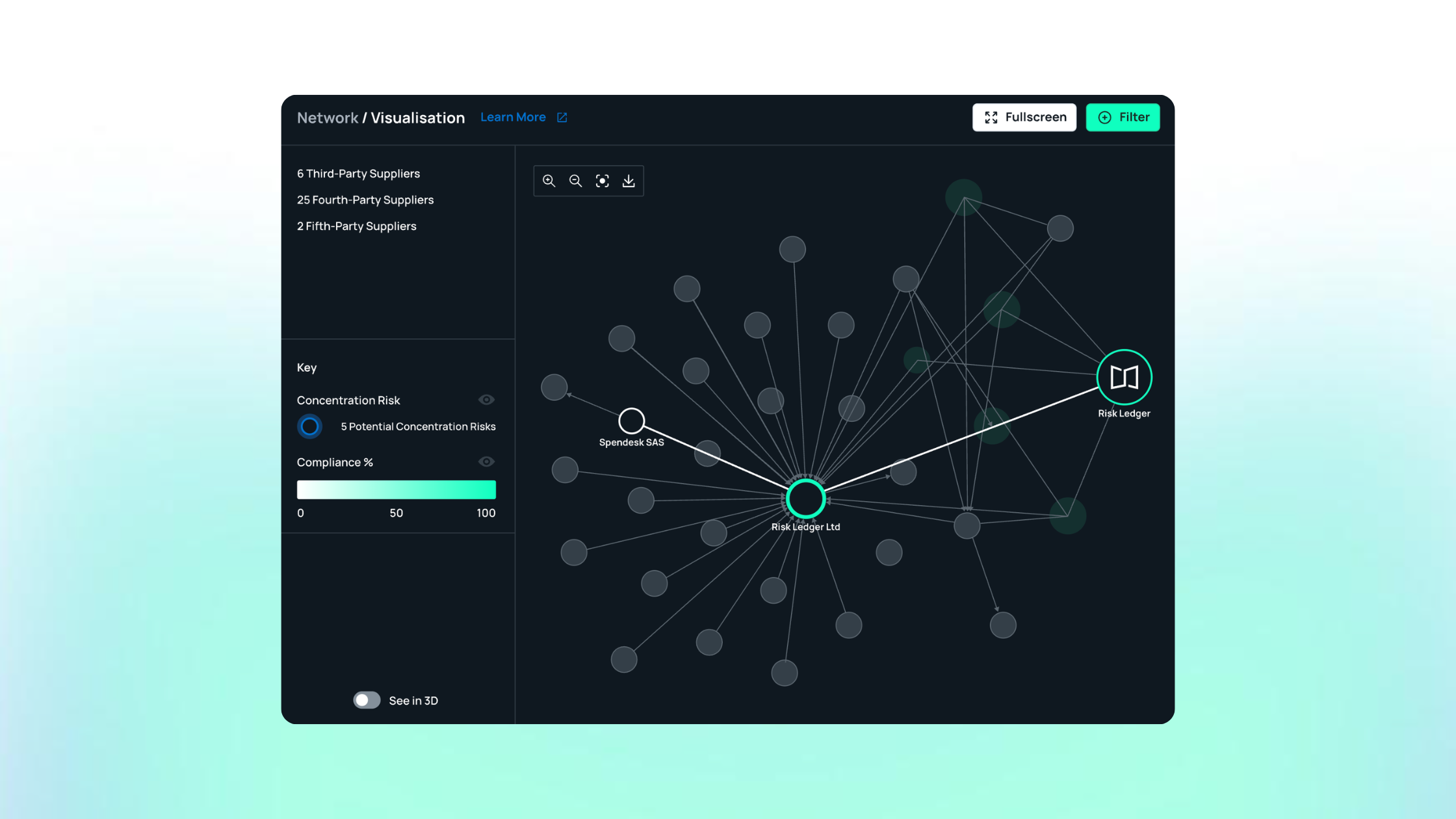
In particular, we arm your security team with a live network map showing nth-party relationships and contextual data on the connections, so they can make operational resilience decisions suited to your organisation's risk appetite and goals.
By joining Risk Ledger, you get access to:
Standardised supplier security information. All suppliers answer a common security assessment based on key regulations and standards, creating a common language of risk for the entire ecosystem.
Connected client-supplier relationships. See how your diverse third-party vendors connect to the wider ecosystem with a real-time map showing third, fourth and nth-party relationships.
Supplier-provided dependency information. Our 16,000+ suppliers create and maintain a standardised and peer-reviewed security profile, highlighting all their security controls and posture, with questions linked to key standards like Cyber Essentials and ISO27001.
Visibility into nth-party relationships. By showing all your third, fourth and nth-party relationships on one map, you can see hidden dependencies, identify single points of failure and better understand how supplier disruptions cascade through the ecosystem.
Identification of shared providers and concentration risk. With a bird's-eye view of your entire network’s changing concentration risks, you can make risk-based decisions and take premeditated action to mitigate disruptions.
Emerging-threat investigation. With real-time risk signals, intuitive dashboards and simulated disruptions, you can assess the impact of emerging threats, create solid response playbooks and make informed choices around supplier diversification.
Direct collaboration with suppliers. Your security team has a direct two-way channel to communicate with third parties and fourth-party vendors. Every supplier can communicate directly over the platform regarding a specific control, fourth-party connection or incident without losing context via email back and forth.
Ultimately, we don’t just provide you with a larger network diagram, but enable you to answer questions such as:
Which direct suppliers depend on this provider?
Which critical services could be affected?
Where are several suppliers exposed to the same dependency?
Which supplier should we contact?
What evidence and remediation information is available?
Is nth-party risk just another name for fourth-party risk?
No, these terms are not interchangeable. Fourth-party risk considers the impact your suppliers' suppliers could have on your organisation. Nth-party risk does not refer to a specific tier, type of supplier or threat, but any exposure originating from supply chain connections beyond your third parties, such as fourth-party payment providers, fifth-party cloud infrastructure or sixth-party data centres.
How far down the supplier chain should an organisation map?
Mapping is not about the depth of connections, but the criticality of these connections. No organisation can, or should, map every potential connection. Instead, focus where there is most risk. Start by using your procurement lists to determine which suppliers provide critical services whose disruption would create the greatest operational, financial, regulatory or customer impact. Then map the connections for those critical suppliers and services.
Do we need to assess every nth-party provider individually?
Focus assessment on nth-party providers that are used by several critical suppliers — our network data found that Google, AWS, Microsoft, Salesforce and HubSpot were the most common. Use your network map to simulate how disruption at critical nth-party providers could impact your business functions and decide where to take action.
How can we identify concentration risk across indirect suppliers?
70% of organisations cannot identify concentration risks among indirect suppliers, largely because they rely on static, Excel-based lists of third-party suppliers. To identify concentration risks, you need live supply chain mapping that provides visibility of both third-party and nth-party connections — showing changing supplier relationships as they happen and helping you monitor and mitigate incidents in real time.
What should we do when an incident affects an nth-party provider?
During supply chain incidents, we recommend following this workflow:
Validate the vulnerability, outage or breach.
Search for direct use of the affected organisation or technology.
.png)
.png)
.png)
.png)
%20-%20thumb.png)



.svg)