November 16, 2026
・
2
mins read

In August 2025, attackers broke into the network of Marquis Software Solutions, a Texas-based vendor that provides marketing, customer relationship and compliance software to more than 700 banks and credit unions. By January 2026, the breach had affected customers of at least 80 banks and credit unions, exposing names, Social Security numbers and financial account information. It all came through a single vendor that many of those institutions may not have ranked among their most critical.
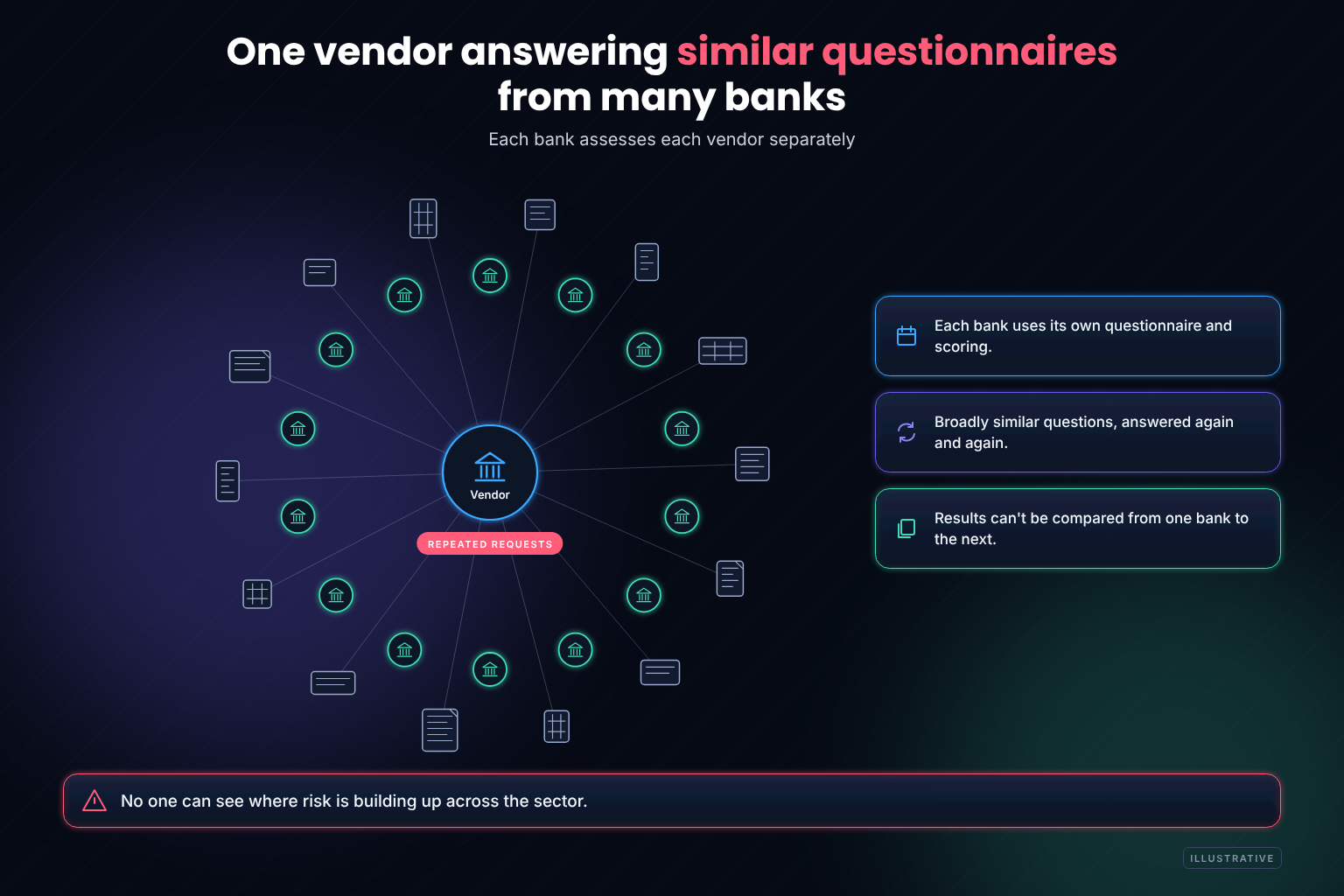
Each of those institutions would typically have assessed Marquis on its own, using its own questionnaire, its own review process and its own risk rating. None of them could see how many peers shared the same exposure, or that a single vendor sat behind so many banks’ customer data. That isn’t a failure of any one bank’s third-party risk team. The problem lies in how vendor risk is managed, not in who manages it.
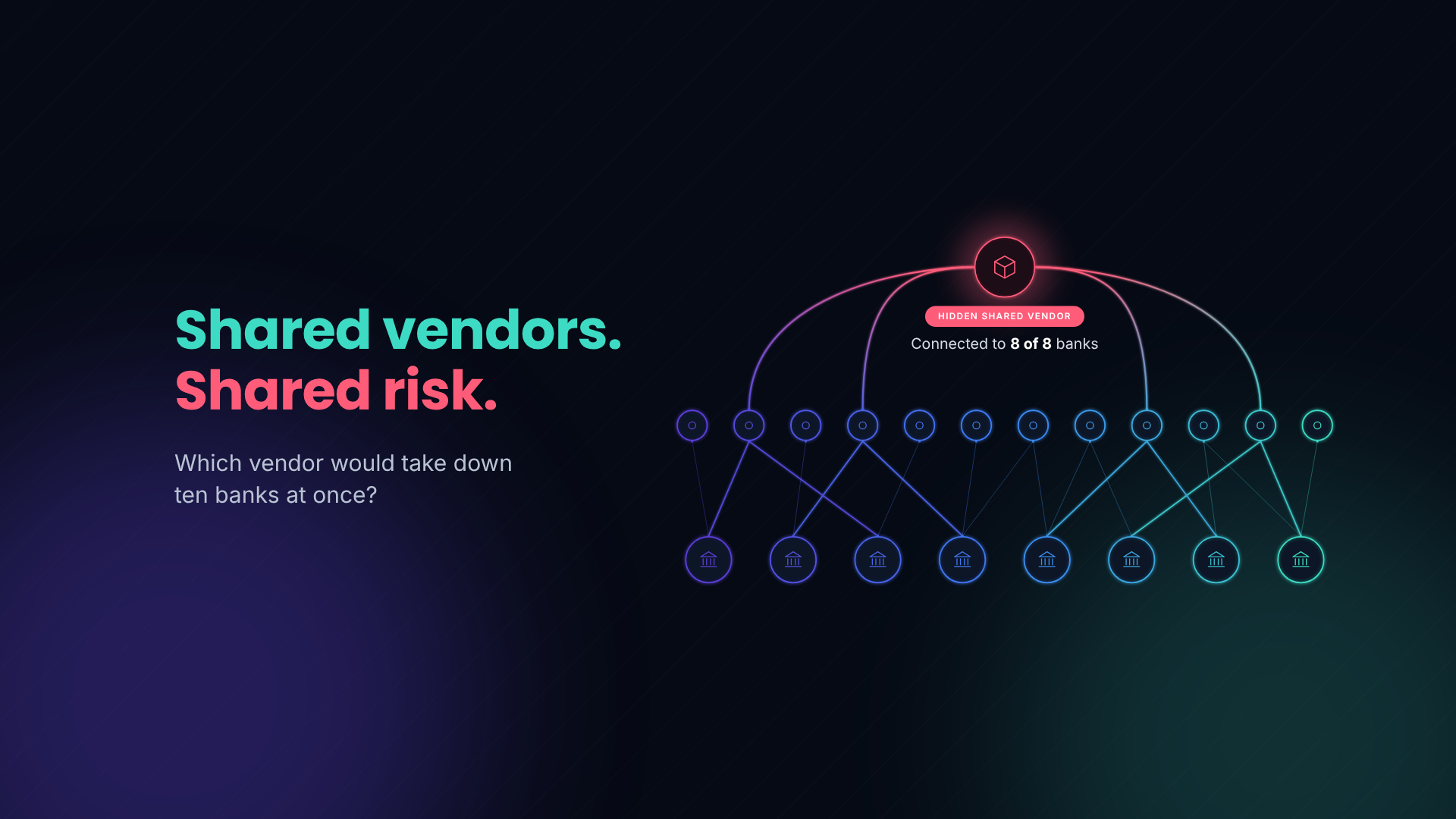
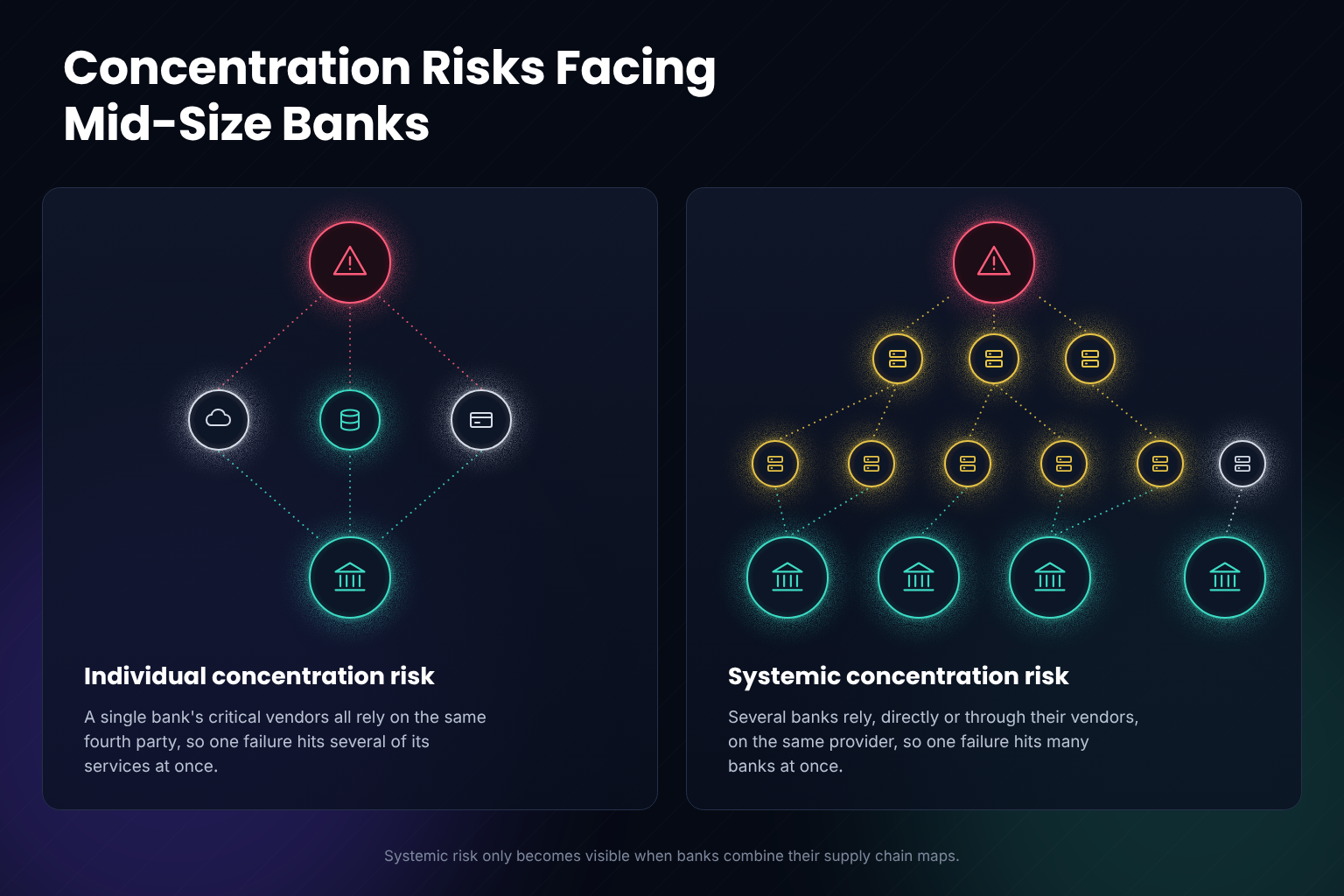
For mid-size banks, this points to a problem no institution can solve alone. These banks rely on many of the same vendors, but each reviews them in isolation. As a result, no one can see where risk is building up across the sector, or which vendors would take down ten banks at once if they failed. However strong a bank’s TPRM program, that picture doesn’t exist inside any single institution. It only emerges when banks collaborate and create a shared view of their combined supply chain ecosystem.
Shared vendors mean shared risk. And shared risk needs a shared view.
Start with core banking. A small number of providers run the core systems for most US banks, and research from the Kansas City Fed describes the market as highly concentrated. Fiserv serves around 42% of banks, Jack Henry around 21% and FIS around 9%, with FIS focused mainly on large and mid-size institutions. Industry data cited in the same research put FIS as the core provider for 78 banks with more than $10 billion in assets. The underlying figures are a few years old, so the exact shares will have changed, but this still demonstrates how a handful of firms still sit behind a large share of the sector’s core systems. A serious outage or breach at one of them would hit many mid-size banks at the same time.
Cores are only the most visible part of the picture. Mid-size banks also share providers of payments processing, digital banking, cloud hosting, data analytics, and marketing and compliance software. Over a third of financial institutions with more than $10 billion in assets work with more than 1,000 vendors, and another third with between 500 and 1,000, according to an Ncontracts survey. Many of these vendors are smaller firms that rarely make a bank’s critical vendor list but still hold sensitive customer data. Marquis was one of them.
Behind those vendors sits a supply chain of their own. Every vendor relies on technology and service providers of its own, and the bank has no contract with them and often doesn’t know who they are. The Marquis breach began with attackers exploiting a known weakness in a SonicWall firewall the company used. A flaw in one product, used by one vendor, ended up exposing customers of dozens of banks. Two banks can use entirely different vendors and still share an exposure, because those vendors rely on the same cloud platform, software product or managed service provider. These deeper layers rarely appear in a bank’s own vendor inventory, which makes shared exposure there especially hard to spot.
Because each bank runs its own third-party risk program, a vendor serving 40 mid-size banks may be assessed 40 times. Each bank sends its own questionnaire, asks for its own evidence and applies its own scoring. The questions overlap heavily but are worded differently, so the vendor ends up answering much the same thing over and over, and the results can’t easily be compared from one bank to the next. Two banks can thus review the same vendor in the same month and reach different conclusions without either of them knowing.
Most of this work falls on small teams. In Ncontracts’ 2026 survey, 63% of programs ran with one or two dedicated staff and 13% had none, while more than half managed 300 or more vendors. Most respondents expected budgets to stay flat. Teams in that position tend to spend most of their time sending and chasing questionnaires, which leaves little room to analyze what comes back.
Vendors feel the strain as well. A provider serving many banks faces a steady stream of near-identical requests, and the answers tend to become slower and more generic. That makes good information harder to get in the moments when it matters the most, such as in the days after an incident.
Mid-size banks also have less leverage than the largest banks when they ask vendors for information. In a Treasury report on cloud adoption, smaller institutions said third-party risk management was becoming more difficult, and industry participants pointed to their weaker bargaining position with major providers. A bank with $20 billion in assets usually can’t negotiate the access and audit rights that a global bank can. Ten mid-size banks asking together carry a lot more weight.
US regulators have set out in some detail what they expect from the largest banks when it comes to withstanding severe disruption. The 2020 interagency paper on Sound Practices to Strengthen Operational Resilience asks firms to identify their critical operations, understand the internal and external dependencies behind them, including third parties, and plan for disruptions such as cyberattacks. It is directed at banks with $250 billion or more in assets, or $100 billion or more with certain risk characteristics. The framework stops just above where mid-size banks sit.
The largest banks have also built a forum to work on systemic risk together. The Analysis and Resilience Center for Systemic Risk was set up in 2016 by the chief executives of the eight US global systemically important banks and was later joined by key financial market utilities. Its work focuses on identifying and reducing risks that could disrupt critical functions across the financial system. No mid-size banks appear among its members.
At the same time, regulatory pressure on third-party risk is easing. In September 2026, the federal banking agencies proposed replacing the 2023 interagency third-party risk guidance with principles-based, non-binding guidance. Whatever its merits, the proposal means less push from regulators. If mid-size banks want a clear view of systemic risk in their supply chains, they will have to build it themselves, and they can only build it together.
Some financial institutions are already building this kind of shared view collaboratively. In the UK, 30 financial institutions have formed a community on Risk Ledger’s platform to identify the concentration risks they share and to be able to respond faster when a vendor incident occurs. Between them, they have connected with 2,780 of their direct third parties on the platform. Mapping those direct vendors’ own supply chains surfaced a further 6,529 supply chain dependencies, and across the combined community map the platform identified 1,322 potential concentration risks.
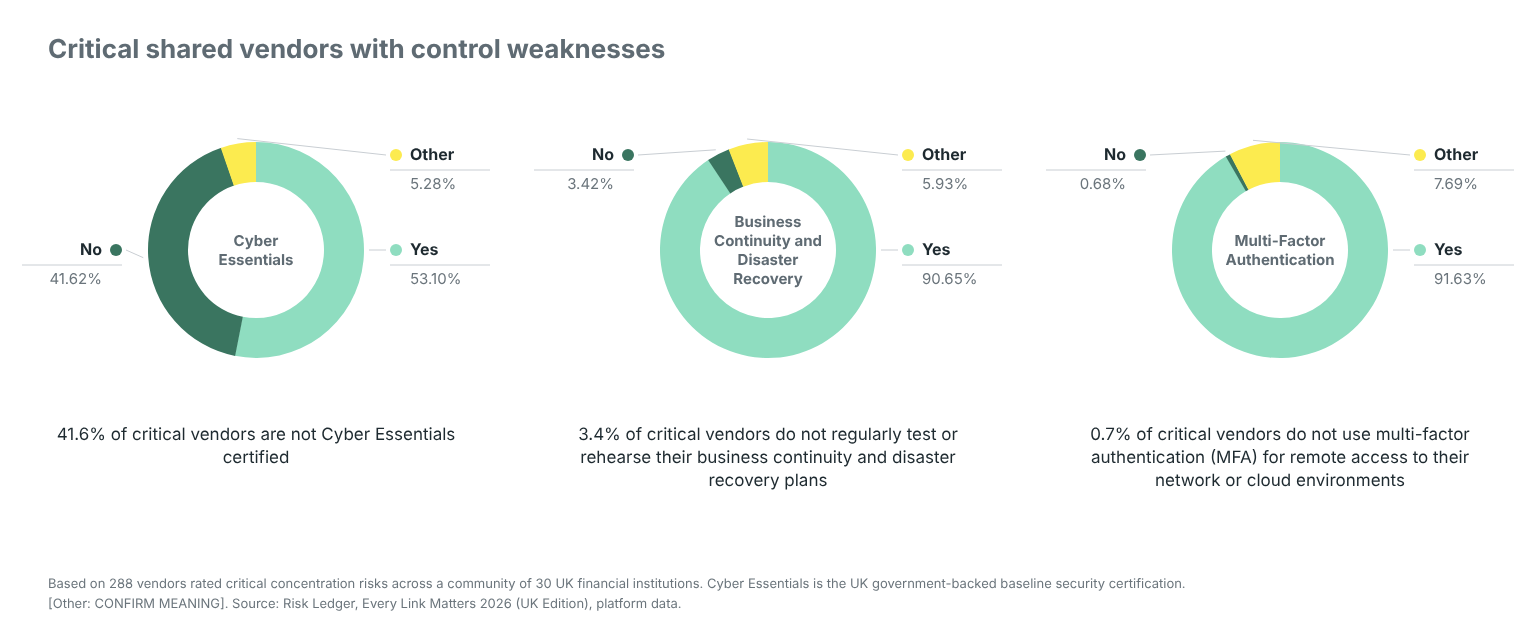
Of those, 727 sat at the third-party level, meaning direct vendors of members of the group. 288 of these were rated critical by members, meaning that were an incident at these vendors to take place, it would likely disrupt essential services at several institutions at once. The data also showed why this information matters and where mitigation efforts could initially focus on. Of the 288 critical vendors, 120 did not hold Cyber Essentials, the UK government-backed baseline security certification, 10 did not regularly test their business continuity and disaster recovery plans, and two were not using multi-factor authentication for remote access control.
Little of this was visible to any one member on its own. Each could see its own vendors and some of their subcontractors, but not how those relationships overlapped with 29 other institutions. By combining their network maps, members can see which vendors deserve closer attention, which fourth parties to raise with their own vendors, and where to focus contingency planning. When a breach hits a shared vendor, they can see straight away who else is exposed and work through the response together.
Examiners are paying more attention to this area. In Bank Director’s 2025 Risk Survey, 24% of respondents said examiners had shown heightened attention to how they oversee third and fourth parties, double the share a year earlier. But an examiner reviews one bank at a time, against what that bank can see. Where risk is concentrated across the sector is a question no examiner can ask a single bank to answer.
The obvious concern is confidentiality, and banks are right to be careful about sharing vendor information with peers. A closed community deals with much of this. Members decide who they collaborate with and what they share, and the focus is on the vendors they have in common, not on each bank’s full vendor list or commercial terms. The appetite for more collaboration with peers is growing too: in a recent Risk Ledger data insights report, based on a survey of 500 UK security and TPRM professionals across different industries, 92% said their organization would support an industry-wide model for sharing vendor intelligence with peers.
For a group of US mid-size banks, the equivalent would be a map of the vendors and fourth parties that sit behind a large share of the group, offering a clear view of where concentration risk is greatest, and a common basis for the questions to put to those vendors.
Risk Ledger is forming a cohort of US mid-size banks to map the sector’s supply chain together, starting in Q1 2027. Participating banks will build a shared view of the vendors and fourth parties they have in common, see where concentration is greatest across the group, and cut down the duplicated work of assessing the same vendors separately.
Places in the first cohort are limited. The map becomes more useful with every bank that joins, and the banks that join first will shape how the cohort works, which vendors it looks at first and how findings are shared. They will also be the first to see the results.
Most mid-size banks rely on many of the same vendors as their peers. A shared view is how each of them can find out what that means for their own bank. Register your interest to find out more about joining the 2027 cohort.



Monthly research, case studies and practical guides you won't find anywhere else.
Join thousands of security managers turning their TPRM programmes into success stories.