October 12, 2026
・
30
mins read

Most security and risk teams are held to an external standard. For some it is a regulator's requirement, such as the NSCS Cyber Assessment Framework (CAF). For others it is a recognised benchmark like ISO 27001, or a board that asks how supplier assurance compares to the NIST Cybersecurity Framework (CSF). These standards are rarely the problem. The challenge is that your suppliers' security information does not arrive in the shape those standards need.
Framework mapping is the work of connecting the two: taking what a supplier has told you and showing which of a framework's requirements it speaks to.
It matters because it turns supplier information into something you can act on. You can see where a supplier already meets the requirements you work to, and where to ask for more.
Across our customer base, we found a strong need for this across government, financial services, insurance, investment, utilities and local councils. CAF alone applies to roughly 370 UK councils and fire services, who are expected to complete CAF returns.
From speaking to users, we learned that teams set up various workarounds to see how suppliers align with the frameworks they work to.
Reading it across by hand
A reviewer takes a supplier's answers and cross-references them against a framework, control by control. While this approach works for a few suppliers, it does not scale as your supplier base grows. One UK public sector team told us that outcome-based frameworks like CAF work well for high-risk suppliers but manually assessing each supplier is not scalable as your supplier base grows.
Sending suppliers a standard-specific spreadsheet
One council we spoke to said their entire assurance process is CAF-based and therefore they send suppliers a spreadsheet of CAF questions.
Building a mapping tool themselves
Some clients take on the work. One client built their own spreadsheet mapping Risk Ledger's Standardised Assessment Framework (SAF), the method we use to collect security data from suppliers, against Cyber Essentials Plus and ISO 27001. Another asked ChatGPT to map it against ISO, NIST and NCSC CAF.
However, a mapping like this is only as reliable as the person who built it and needs rebuilding whenever the supplier assessment is updated, or the target framework changes.
Whichever route a team takes, the same problems follow:
We built Framework Mapping to take that work off your team.

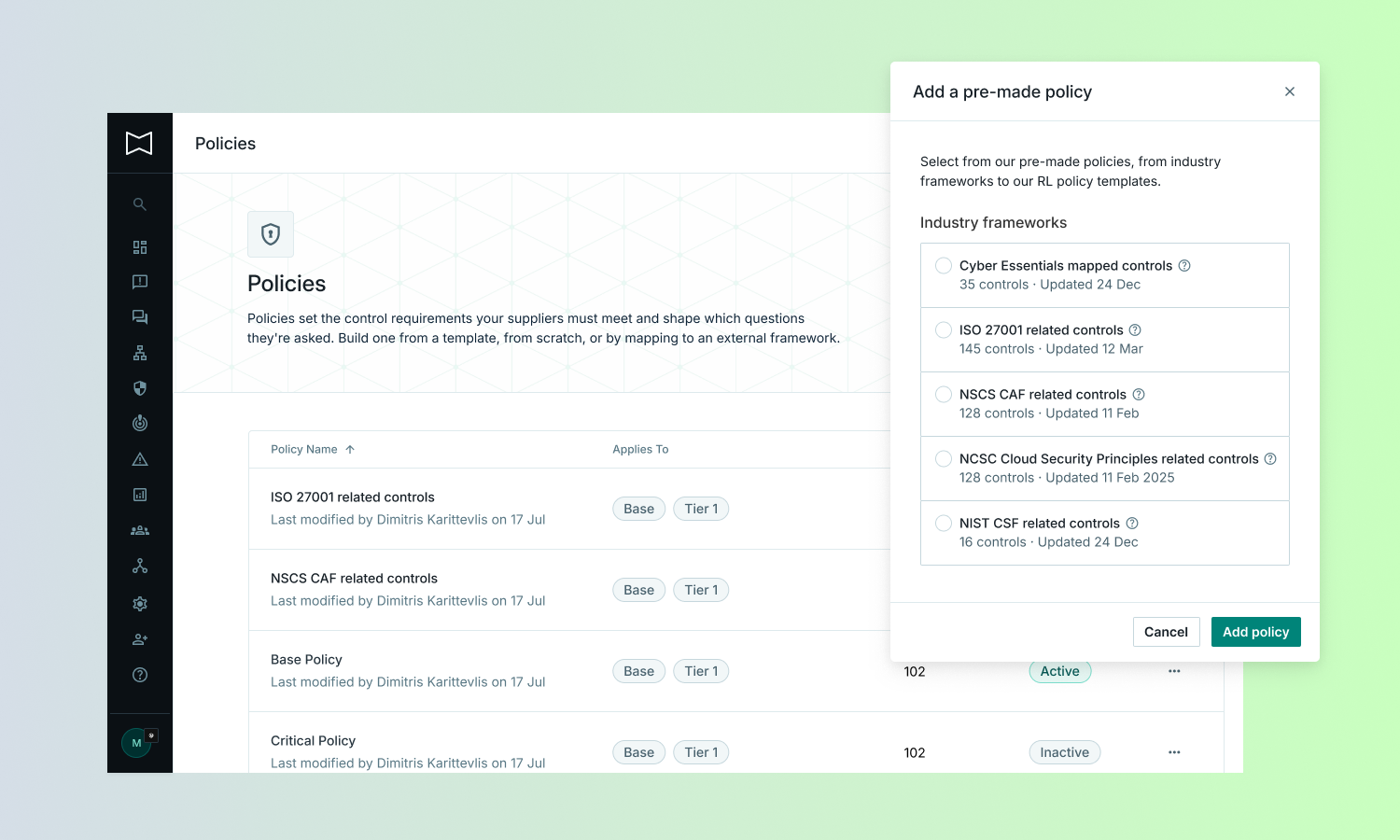
Framework Mapping lets you apply a pre-built policy to your suppliers and see how their existing Risk Ledger assessment aligns with a framework. For now, it covers five frameworks:
In the platform, we've added Pre-Built Industry Framework Policies, where each policy includes the controls relevant to each industry framework. Apply the policy to relevant suppliers to see how they perform against the mapped controls, using their existing assessment responses. Framework Mapping does not change how supplier compliance scores are calculated.
We have also published a mapping sheet that shows how our controls address each requirement within each framework, accompanied by notes on where and why coverage is partial.
You can skip the manual cross-referencing, and in many cases the extra questionnaire too. You use what your suppliers have already provided, and suppliers don't have to answer multiple assessments from the same client.
A few things make this more useful than doing it by hand:
Framework Mapping shows how Risk Ledger controls map to and align with a framework. It points you to what a supplier is asked in the assessment, not how a supplier has answered.
It is not a certification, and it is not audit or regulatory evidence. A supplier's answers show how they align with a standard, but that does not mean they hold its certification or have passed a formal assessment.
We started where we found the strongest need. The five frameworks are the ones our users asked for most, through customer conversations and feedback from our commercial teams.
We then worked with an external cyber security consultant to map each framework requirement against all 285 controls in Risk Ledger's Standardised Assessment Framework (SAF), with an explanation of how our controls meet it.
Every requirement is rated Fully, Partially or Not covered. We have erred on the side of caution: where there was any doubt about full coverage, we recorded Partially.
Here is how the SAF covers each framework:
We have not tried to reach 100% for its own sake. Some requirements are commercial or contractual commitments that a supplier security assessment cannot establish. Other requirements are so detailed that asking every supplier about them would slow down assessments and unlikely change your decision.
Where a control needs a threshold, such as how often a supplier runs vulnerability scans, the industry frameworks do not set a number. We set a baseline, informed by our own policies and by what clients most commonly require. You can adjust these thresholds within the platform.
While an LLM, a spreadsheet, a generalist GRC tool, or procurement tool can produce a mapping, keeping it right is the harder part.
Here is what a specialist mapping adds.
Framework Mapping is available now in the platform. To add a policy, see our help article. To request the mapping sheet, contact support@riskledger.com or speak to your Customer Success Manager.
Not yet a Risk Ledger client? Book a demo call with us to learn more.

Monthly research, case studies and practical guides you won't find anywhere else.
Join thousands of security managers turning their TPRM programmes into success stories.


.svg)